Black Mold vs Mildew: How to Tell, What to Do, and When to Worry
You see a dark patch in the bathroom. Or a white powdery patch on the grout. Someone calls it mildew. Someone else calls it black mold. The names scare people in different ways, but the names are not the job. The job is always the same. Find the water. Dry the wall. Learn how far it goes.
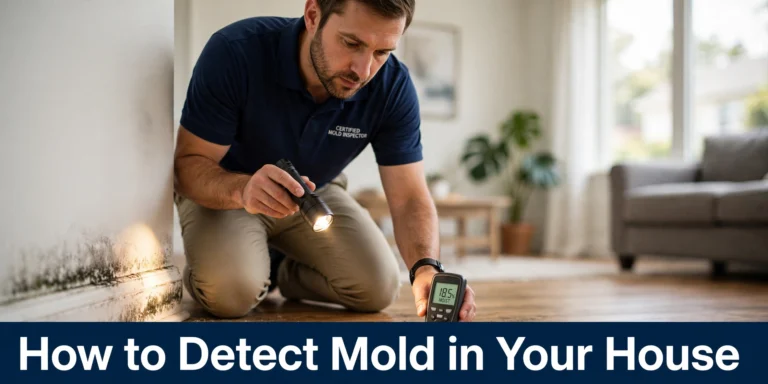
I inspect homes for mold. I do not sell cleaning. I do not sell coatings. I do not sell air purifiers. My job is to find the moisture and the scope, so you do not spend money on the wrong fix. This article follows that order.
What is the real difference between black mold and mildew?
Mildew is a kind of mold, not a different thing.
That is the first fact, and it clears up most of the fear.
The United States Environmental Protection Agency, the EPA, updated its page on June 23, 2026. It says mildew refers to certain kinds of mold or fungus, and the term mildew is often used generically to refer to mold growth, usually with a flat growth habit.
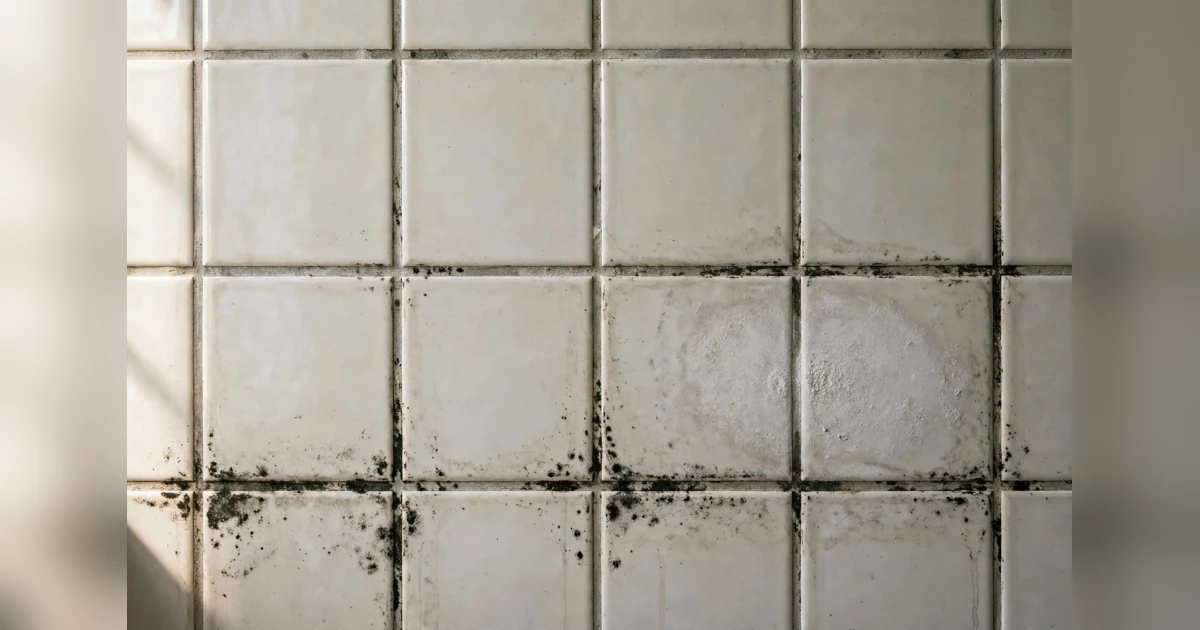
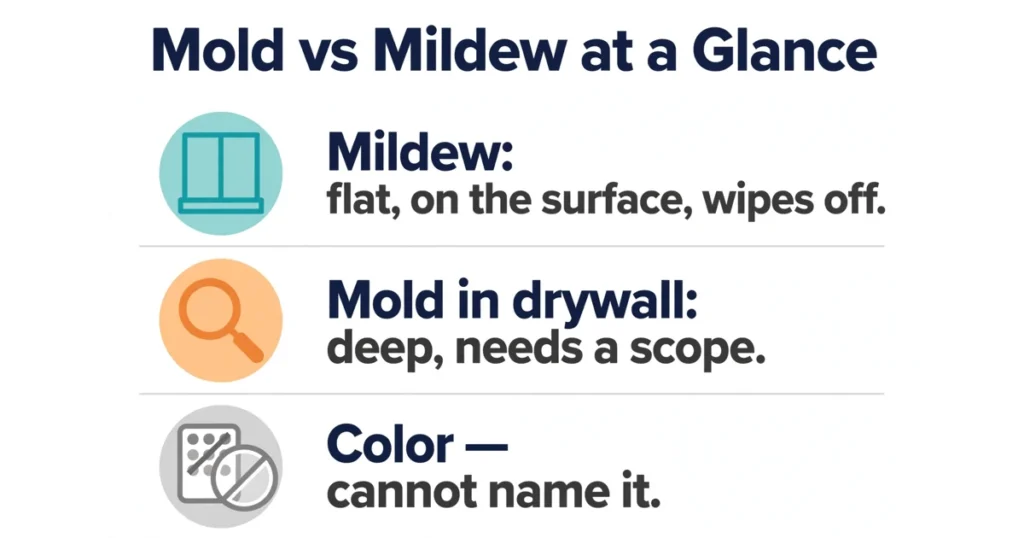
In plain words, mildew is mold that lies flat. It often sits on shower walls, grout lines, and windowsills, where moisture stays high. It wipes off the surface more easily than growth that has roots deep in a wall. But it is still mold.
The word mildew came from plants. Powdery mildew is a plant fungus. People took that plant word and used it for bathroom growth. That is where the confusion started. Michael Rubino, a mold professional known as The Mold Medic, puts it plainly in a published interview. Asked what the difference between mildew and mold is, he answers that there is none. He adds that when you are looking at mildew in your home, it is typically just mold.
The question is not black or white. The question is wet or dry.
Is black mold always Stachybotrys?
No. Black is a color, not a species.
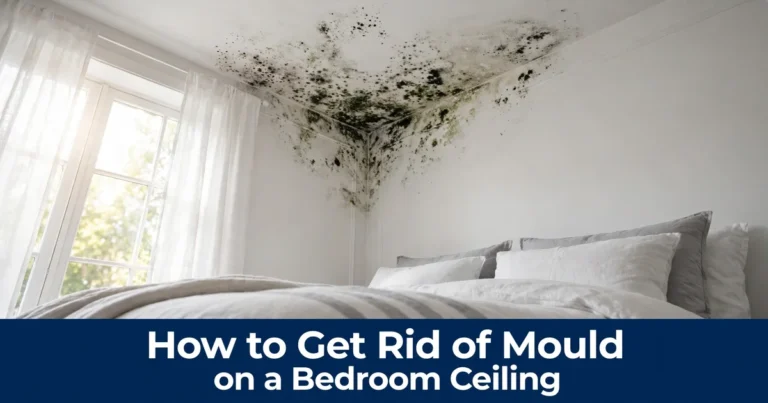
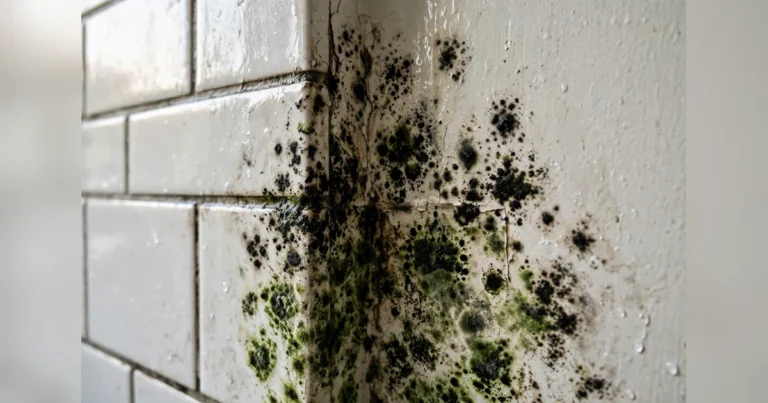
Many molds look black. Aspergillus niger looks black. Cladosporium looks dark. Stachybotrys chartarum, the mold people call black mold, is greenish black and slimy. It grows on materials that stay wet for a long time, like drywall, wood, and paper. But you cannot prove it is Stachybotrys by looking at it. Only a lab test of a sample can name the species, and even then, the name alone does not prove a health risk.
Black is a color, not a diagnosis. The wall cannot tell you the species.
The Centers for Disease Control and Prevention, the CDC, says no test exists that proves an association between Stachybotrys chartarum and particular health symptoms. The CDC also says all molds should be treated the same for health risk and removal. That is why this article does not rank molds from safe to toxic. It ranks jobs from simple to serious. A flat patch on tile is one job. Growth inside drywall is another job.
| What you see | What it often means | What it does not prove |
|---|---|---|
| Flat, powdery, white or gray patch on tile or grout | Surface growth, often called mildew | That it is harmless, or that it is one species |
| Raised, fuzzy, or slimy dark patch | Growth with more body, often deeper | That it is Stachybotrys, or that it makes toxins |
| Pink slime in the shower | Bacteria, not fungus, in most cases | That mold spray will fix it |
| White powder on concrete | Salt left by drying water, in most cases | That spores are growing there |
These are tendencies, not rules. Color, texture, and shape give hints. They never give a diagnosis.
What do people believe about mold and mildew?
Much of what people believe about this comes from old sayings, not from science.
Old houses carry old advice. Here are the sayings I still hear, and what is true about each one.
“If it is mildew, it is harmless.” This is the most common myth, and the most costly. Mildew is mold. California’s health department, the CDPH, says any type of mold that you see or smell in your building is a risk to your health and should be fixed, and the more mold or moisture you see or smell, the greater the risk. A small patch on grout is a cleaning job. Growth in drywall is a moisture investigation. The name does not make it safe.
“If it is black, it is toxic poison.” Black is a color. Some black growth is Stachybotrys. Much black growth is not. Fear of the word toxic has sold many test kits, coatings, and purifiers. The CDC position is calmer and clearer: treat all molds the same, remove the growth, and fix the water.
“Bleach kills it all.” Bleach can kill surface mold on hard, non-porous surfaces, but dead mold can still cause allergic reactions. The EPA does not recommend biocides like bleach as a routine practice for mold cleanup. The CDPH goes further and does not recommend bleach at all, because bleach can harm breathing, and soap and water clean well enough. The honest point is simple. Killing is not the goal. Removing the growth and drying the wall is the goal.
“Paint over it and it is gone.” Paint hides growth. It does not fix dampness. The CDPH says painting over mold, even after applying a biocide, will not fix mold and dampness problems. Rubino says the mold will just continue to grow behind the paint and cause a bigger problem than you first had.
“A test kit will tell me if it is dangerous.” A home test kit cannot name the species with certainty, cannot measure your health risk, and cannot show how far growth goes inside a wall. The CDC does not recommend routine sampling. I explain why in the testing section below.
“An air purifier will fix it.” A purifier cleans air. It does not dry a wall. The CDPH says running particle-removing air filters or air cleaners will not solve a mold problem. If the wall stays wet, growth stays too.
“Mildew turns into black mold if you leave it.” People argue about this online, and forums show both views. The EPA position settles the science part: mildew is already a kind of mold. It does not need to turn into something else to matter. What changes over time is not the name. It is the damage, as moisture stays and growth spreads deeper.
No survey in this research measured what share of people believe each myth, so this article gives no percentages for beliefs. Inventing a percentage would be worse than saying plainly that these beliefs are common. They are common. I hear them in real homes, and forums are full of them.
Can you tell by color, smell, or touch?
No. Your eyes and nose can find growth, but they cannot name it.
Color gives a hint. Texture gives a hint. Smell gives a strong hint. None of them gives a name.
Flat and powdery growth that wipes off easily is often surface growth. Raised, fuzzy, or slimy growth that leaves a stain or shadow after wiping has likely rooted deeper. A patch on tile is different from a patch in drywall, even when both look dark.
Smell matters more than most people think. A musty smell with no visible patch is not a mystery. It is a hidden patch. Rubino says when you can smell mold, chances are there is a serious problem. In plain words: smell means growth is somewhere, even if your eyes cannot find it yet. Check behind the wall, under the sink, around the laundry, and in the crawl space. Do not just spray the air.
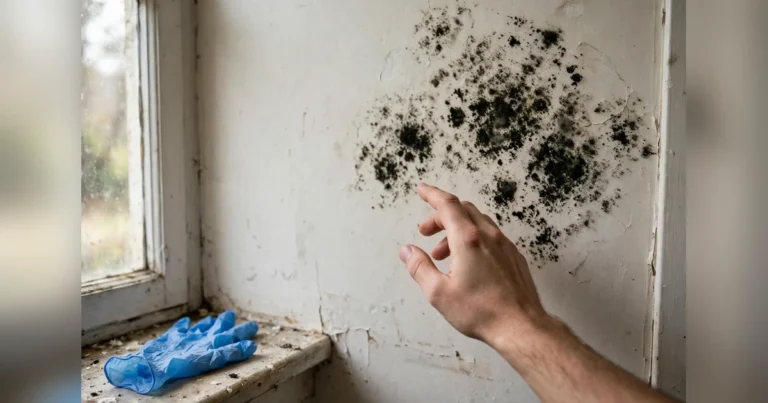
Touch has limits too. Do not scrape growth to identify it, and do not sniff it closely. Wear gloves. If the patch feels soft, if paint bubbles, or if drywall feels swollen, water has been there longer than the patch shows.
And no photo can settle it. People post photos online and ask strangers to name the growth. Strangers guess from texture and shape. A photo cannot show what is inside the wall, and it cannot name a species. Only a lab sample can name a species, and as the CDC says, you do not need the name to act.
Is mildew dangerous, or can I ignore it?
Do not ignore it. Mildew is mold, and mold in your home needs attention.
That does not mean panic. It means order. Small surface growth on tile or grout is a cleaning job. Growth in drywall, under flooring, or behind a wall is a moisture investigation. The size, the place, and the water behind it decide the job, not the word mildew.
Health risk follows the same order. The CDPH links visible mold, visible moisture, water-damaged materials, or mold odor in a building to increased risk of asthma development, asthma flare-ups, allergies, respiratory infections, and breathing symptoms. People with asthma, allergies, or weak immune systems feel it first. Children and older people feel it more. But risk grows with more mold and more moisture, not with a scarier name.
So the rule is simple. Clean what is small and on the surface. Scope what is large, hidden, or coming back. Never call a patch safe just because someone called it mildew.
What should I do first when I find it?
Stop the water first. Then clean what you can reach, and scope what you cannot.
Follow these steps in this order.
- Put on gloves. Do not touch growth with bare hands. Open a window or run the fan.
- Find the water. Look for a leak, a drip, a wet wall, a bad seal, or a fan that never runs. Growth without water does not last.
- Dry the area. Wet items need cleaning and drying within 48 to 72 hours after a flood or leak, per CDC guidance. A fan and a dehumidifier help. Heat alone does not fix a leak.
- Clean hard surfaces with soap and water. Scrub, rinse, and dry fully. This is the CDPH way, and it works for tile, glass, plastic, metal, and ceramics.
- Check what is behind it. If paint bubbles, drywall feels soft, or the patch comes back fast, water is still there. That is when you scope it, not just scrub it.
PuroClean inspector Steve Scott says it in one line: “You can’t have mold without water.” He also gives the humidity number that guides action: keep indoor humidity at 30 to 50 percent with a dehumidifier. The EPA gives the same 30 to 50 percent range. The CDC says keep humidity below 50 percent. These numbers agree in practice. Keep your home under 50 percent, and drier is better for walls.
If the growth covers a large area, hides inside walls or ceilings, keeps coming back, or comes with health symptoms that do not clear, get an inspection before you spend on cleaning or repairs. An inspector finds the moisture source and the scope. A cleaner only cleans what shows.
How do I clean it, and what should I never do?
Clean hard surfaces with soap and water, and never paint over growth.
Hard, non-porous surfaces like tile, glass, plastic, metal, and ceramics can be cleaned well. Scrub with soap and water, rinse, and dry fully. Wear gloves, and wear goggles and a mask if the area is large or dusty.
Porous materials are different. Drywall, ceiling tiles, drapes, and soft furniture absorb water. The CDPH says these usually cannot be cleaned well once mold grows in them. Porous materials that stayed wet for more than a day or two may need removal, even if they do not yet look or smell moldy. That is not upselling. That is how wet material works.
Mildew on the grout line and mold in the drywall are two different jobs, even when they share a bathroom.
| Surface | What to do |
|---|---|
| Tile, glass, plastic, metal, ceramics | Scrub with soap and water, rinse, dry fully |
| Grout lines with surface growth | Scrub, rinse, dry, then seal grout only after it is fully dry |
| Caulk with growth inside it | No cleaner fixes it, remove the old caulk and put new silicone caulk |
| Drywall, ceiling tiles, soft furniture | Usually cannot be cleaned well once wet and moldy, removal is often needed |
| Painted wall with bubbling paint | Water is inside the wall, scope it before repainting |
What should you never do? Never paint over growth. Paint over growth and you have not cleaned it. You have hidden it and fed it. Never mix cleaners to make them stronger. Never mix bleach with ammonia or other cleaners. Never rely on a spray alone while the wall stays wet. Killing the growth without drying the wall is mopping while the tap still runs.
People argue online about bleach versus vinegar. Forums show both camps. One camp says bleach works best. Another camp says vinegar kills spores while bleach only fades stains and leaves moisture behind. Here is the honest version. Bleach can kill surface mold on hard surfaces, but dead mold can still cause allergic reactions, and the EPA does not recommend biocides as a routine practice. The CDPH does not recommend bleach at all. Soap, water, drying, and fixing the water source beat any bottle. If you use a cleaner, follow its label, wear gloves, ventilate the room, and dry the surface after. No cleaner replaces drying.
Why does it keep coming back?
Because the water never left.
A patch that wipes off and stays off was surface growth. A patch that returns in days is a leak talking.
Use returns as a test. Growth back in days points to a leak, a wet wall, or growth behind the surface. Growth back in weeks points to a habit or ventilation problem, like a fan that never runs, a door that stays shut, or a shower that never dries. Rubino says it the same way: if it comes back in a few weeks, that points to a larger mold problem existing in the home.
| When it returns | What it often means | What to do |
|---|---|---|
| In days | Leak, wet material, or hidden growth | Find the water source and scope behind the surface |
| In weeks | Habit, fan, or ventilation problem | Run the fan every shower, dry the shower, open the door, check humidity |
| After painting over it | Growth was hidden, not fixed | Remove paint, find moisture, clean or remove the material |
Cleaning the same patch five times is not bad luck. It is a moisture source you have not found yet.

Do I need a mold test?
In most cases, no.
The CDC says it plainly. If you see or smell mold, remove it. You do not need to know the type of mold. The CDC also says it is generally not necessary to identify the species of mold growing in a building, and it does not recommend routine sampling.
The CDPH says the same in stronger words. You do not need to measure the amount or identify the type of mold. There are no recommended unhealthy levels for spore concentrations or for particular kinds of molds. Most importantly, measuring molds does not tell you if there is a health problem.
No home test kit can name the mold, and no color chart can either.
When does testing help? It helps when you need a documented scope, for example in a landlord dispute, or when a doctor asks for lab context. Even then, testing answers what species is present, not whether your home is safe. And no mold test can show when cleanup has succeeded. The CDPH says the best sign of success is simple: the moisture source is fixed, damaged materials are cleaned or removed, and what is left is dry and free of visible mold and mold odor.
So spend on scope first. An inspection tells you how far growth goes and where water comes from. A test kit tells you a name, and the name was never the job.
What if my landlord calls it just mildew?
The name your landlord uses does not change your rights or the moisture.
Tenants report a pattern. A landlord looks at growth, calls it just mildew or probably mildew and not mold, and paints over it. The tenant worries it is mold. The paint hides it. The moisture stays. This pattern shows up in forums and in tenant stories across the country. It is a dispute pattern, not a fact about any one landlord. But if it happens to you, the steps are clear.
In California, landlords must provide a unit that is fit to live in. The California Housing Code says that if dampness or visible mold in a dwelling is a danger to the health of occupants, the dwelling is substandard and the owner must fix it. The State Housing Law, California Health and Safety Code section 17920.3(a)(13), says visible mold growth, as determined by health or code enforcement officers, would deem a residential building substandard. California also has the Toxic Mold Protection Act, known as SB 732, in the same area of tenant protection law.
If the landlord calls it just mildew, ask what the moisture is doing behind it.
Put it in writing. Take dated photos. Notify your landlord in writing and keep a copy. Ask for the moisture source to be fixed, not just the surface painted. If the landlord will not act, contact your local code enforcement agency. The CDPH itself does not visit homes or enforce housing codes. Local code enforcement handles inspections and enforcement.
Other places moved on this in 2026, and the contrast helps California renters see what is possible. Philadelphia passed a Safe Healthy Homes Act in May 2026, with an owner attestation, a 30 day correction deadline, and proactive inspections, effective November 2026. Scotland put Awaab’s Law into force in October 2026, with investigation deadlines for landlords. These are not California law. They show the direction: deadlines, written findings, and fixing the source, not painting over it.
What is new in 2026?
2026 brought mold back into national news, but the home rules did not change.
In September 2026, the United States Department of Health and Human Services hosted a Mold Surveillance Roundtable in Washington, DC, marking ten years of Fungal Disease Awareness Week. The focus was invasive mold disease, surveillance, and diagnosis, not household mold versus mildew. It still matters for one reason. It produced CDC burden numbers that news stories now quote. The CDC estimates 7,288 United States deaths per year and 19.37 billion dollars in total national costs per year from ALL fungal diseases, including mold infections like aspergillosis along with other fungi. That number is not a household mold number. Do not let anyone use it as one.
In January 2026, Congress saw the MOLD Act, House bill 7188, introduced by Rep. Jimmy Panetta of California. It would require independent inspections of privatized military housing at move out, on safety complaints, and after repair work, with pass or fail results shared with tenants. It defines acceptable indoor humidity as less than 50 percent. It covers military housing only, not private homes. But it shows the same standard this article uses: inspect, share results, fix the source.
In 2026, New York City’s Mold Busters program gave the strongest home evidence of the year. The program, started in 2019, was linked to fewer asthma emergency visits among public housing residents. The journal version, published in August 2026, found an average annual reduction of 7.2 asthma related emergency visits per 1,000 residents, or 2,200 fewer annual visits from 2022 to 2023, which is 19 percent lower than expected. A conference version gave a higher figure, 9.0 per 1,000 residents. The journal version is the later published one, and the gap between versions is noted here honestly. The study was observational, in public housing only, and it still points the same way as everything else in this article: fixing mold in homes helps breathing.
Tenant stories filled 2026 news too, from Atlanta to St. Louis to Toledo to Tucson to Fairview, Tennessee, and to Ealing in West London. The pattern repeats: growth painted over, complaints unanswered, families forced out. Those stories are allegations and tenant accounts, not court findings. They belong here because they show why the landlord section above matters in real life.
The history behind all of this is older than the news. People used to say bleach fixes everything, paint seals everything, and mildew is harmless. Those sayings came from a time when no one checked what was behind the wall. The science moved on. The EPA updated its mold versus mildew page in June 2026. The CDPH and CDC positions are clear. The old sayings are not.
What do Santa Barbara homeowners ask me?
In Santa Barbara homes, I hear the same questions, with a coastal twist.
Santa Barbara adds moisture in its own way. Marine layer fog, cool damp mornings, older homes, bathrooms with weak fans, laundry rooms behind bedroom walls, windowsills that collect condensation, and crawl spaces that stay damp. The growth looks the same as anywhere else. The water sources have a coastal pattern.
The questions I hear most are the same questions people ask online, because people worry about the same things everywhere.
Is the black stuff dangerous? Color cannot answer that. Scope and moisture can.
Can I just bleach it? Soap, water, and drying beat a bottle, and no cleaner fixes a wet wall.
Should I test it? In most cases, no. Scope it first.
My landlord says it is just mildew. The name does not change the moisture, and California law does not care what it is called. It cares whether the home is fit to live in.
Is the pink stuff in my shower mold? Pink slime is usually bacteria, not fungus. Mold spray fights the wrong enemy there. Clean it, dry the shower, and watch whether it returns.
Is the white powder on my concrete wall mold? White powder on concrete is usually salt left by drying water, not spores. Wipe it, and check whether water is coming through the wall.
No survey of Santa Barbara customers exists in this research, so this section gives no percentages and no invented quotes. It gives the coastal pattern and the real questions, because those are what a Santa Barbara homeowner needs to act on.
When does it need a professional?
When it is big, hidden, recurring, or in the material itself.
The EPA gives a size guide with care. If the moldy area is less than about 10 square feet, roughly 3 feet by 3 feet, in most cases you can handle the job yourself. Note the two soft words: about, and in most cases. Above that size, or when growth hides inside walls or ceilings, keeps coming back, or comes with health symptoms that do not clear, get a professional scope.
Get an inspection before you spend on cleaning, repairs, or products. An inspection answers three questions no bottle can answer. How far does it go? What is wet behind the surface? Where does the water come from? Our Mold Testing page explains how air and surface samples work, and our Black Mold inspection page explains what a full inspection covers.
Call it mildew or call it mold. The moisture does not care what you named it.
If you see growth, smell mustiness, or keep cleaning the same patch, get a free estimate and a clear scope first. Call us at (805) 765-0923 or visit our Contact page. We inspect. We find the water. We tell you the scope in plain words, so you spend money on the right fix.