Does Hydrogen Peroxide Kill Mold? What It Does, What It Cannot Do, and When to Stop Spraying
Short answer
Yes, on a hard surface, with limits. No, it is not a fix for a damp wall.
Most household guides say 3 percent hydrogen peroxide kills mold on hard, nonporous surfaces like tile, glass, metal, and plastic. Spray it on, leave it about 10 minutes, scrub, wipe, and dry. One guide says the opposite, that peroxide removes mold but does not kill it.
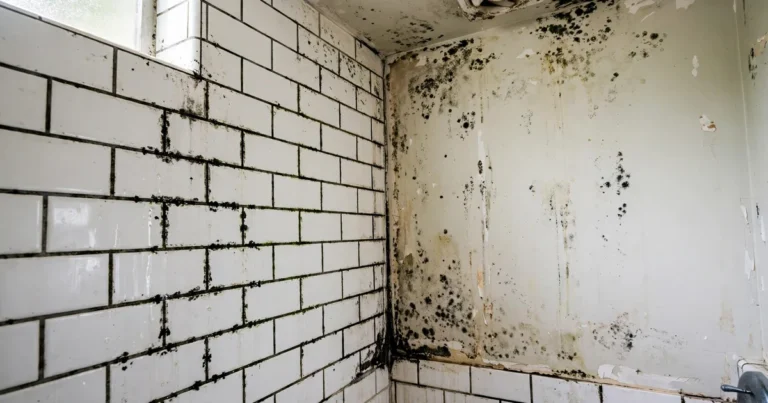
Peroxide can clean the patch you see. It cannot dry the wall behind it.
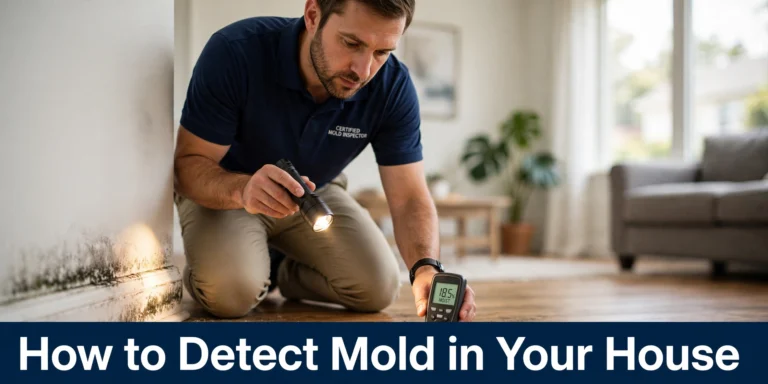
I inspect homes for mold. I do not sell cleaning products. My job is to find the moisture and the scope.
Quick facts
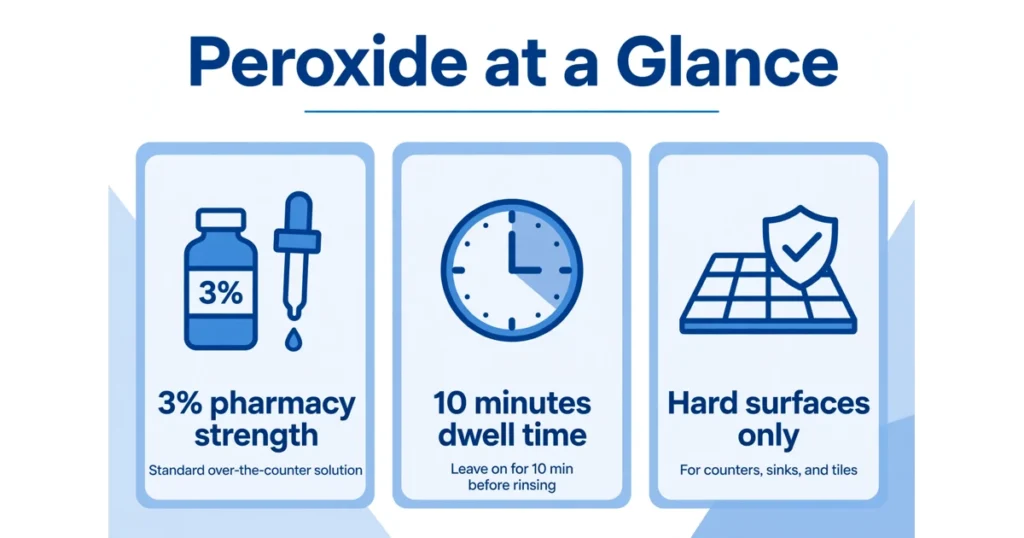
- Standard strength: 3 percent, undiluted, from the pharmacy bottle.
- Standard dwell time: about 10 minutes, then scrub, wipe, and dry.
- Best case: small, visible growth on a hard surface you can reach.
- Weak case: growth inside drywall, wood, carpet, or behind a wall.
- Never mix peroxide with vinegar or bleach in one bottle.
- Dead mold still needs removing, because dead does not mean gone.
- If it comes back fast, the problem is water, not the spray.
Does hydrogen peroxide kill mold?
On hard surfaces, most guides say yes. On porous material, guides split.
Peroxide is a simple chemical, H2O2. When it touches mold, it breaks down and gives off oxygen, which you see as fizz. The fizz is a reaction, not a report card.
Peroxide is not new. A French chemist found it in 1818, and the first EPA pesticide registration came in 1977. Cleaning expert Jon Riding, quoted by The Spruce, says it breaks mold down at the cellular level, while air quality expert Michael Rubino adds that it is more complicated than spraying it on and calling it a day.
The Mould Doctor, an Australian guide, says the opposite: peroxide removes mould but does not actually kill it, citing an EPA perspective. The EPA guide checked in this research does not mention peroxide at all, so that EPA link is the page’s wording, not a verified EPA position. What guides agree on is the next step either way: remove the growth, dry the surface, fix the water.
Mold is common. A roundup citing NIOSH states that nearly 47 percent of residential buildings in the United States show visible mold or mold odor. That is a roundup figure, not a fresh census.
What strength should I use?
Use 3 percent. Stronger is not smarter when the bottle can burn skin.
The household standard across nearly all guides is undiluted 3 percent, the pharmacy strength. One seller page adds 6 percent for heavy mold on grout and tile, but that is a seller claim, not an independent test result. The same seller page gives dilution math from 35 percent concentrate: 1 part peroxide to 10.7 parts water for 3 percent, and 1 part to 4.8 parts water for 6 percent.
Higher strengths carry burn and eye injury warnings, and one guide tells untrained homeowners to stick with 3 percent. A 12 percent strength appears only in the title of an unread online thread, so no verified advice about 12 percent is given here. Food grade 35 percent concentrate appears only in a seller dilution table. It is not a household spray.
| Strength | What is verified | Safety note |
|---|---|---|
| 3 percent | Standard across nearly all guides | Gloves, ventilation, spot test first |
| 6 percent | Seller page only, heavy grout and tile | Seller claim, not an independent test |
| 12 percent | Only in an unread thread title | No verified advice given here |
| 35 percent concentrate | Seller dilution table only | Can burn skin and eyes |
How do I use it, step by step?
Spray, wait, scrub, wipe, dry. In that order, every time.
- Put on gloves. Wear goggles and a mask if the patch is large or dusty. Open a window or run the fan.
- Spot test first. Put a little on a hidden corner and check for bleaching before you spray wide.
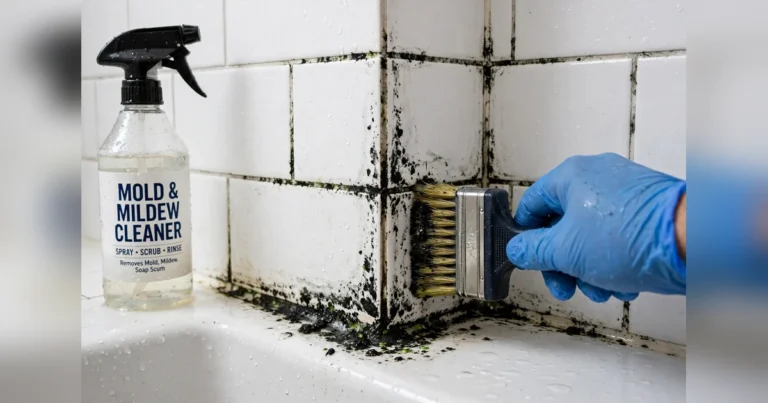
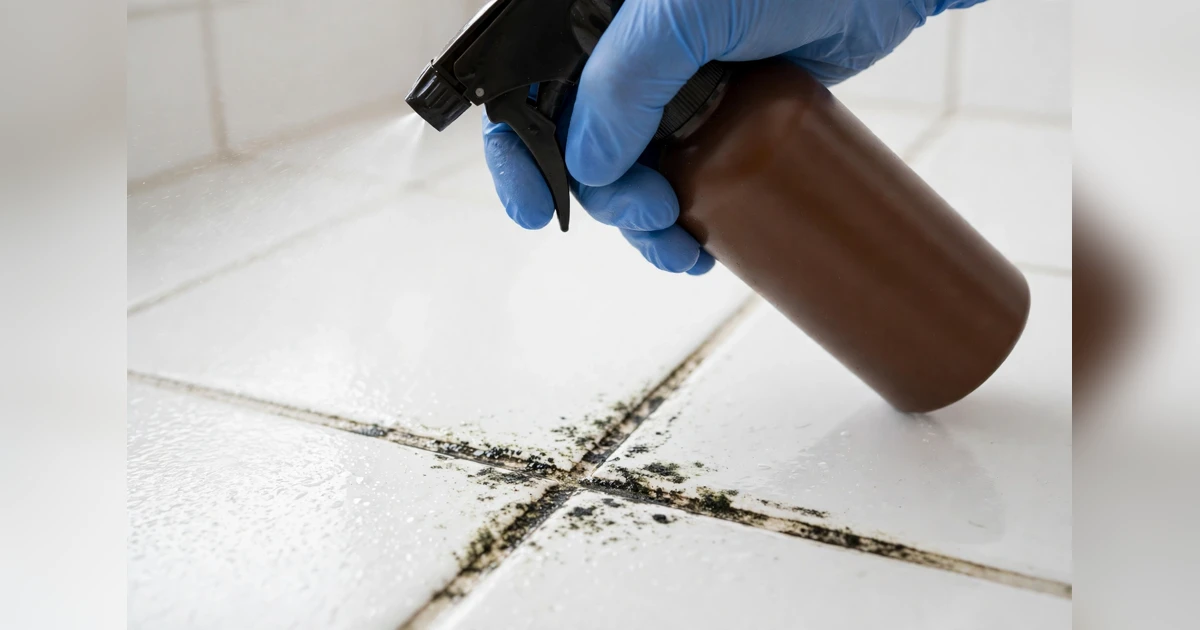
- Spray undiluted 3 percent peroxide on the growth until the surface is wet. Do not flood it.
- Leave it about 10 minutes. Do not wipe it off early.
- Scrub with a brush or cloth. Then wipe the surface clean.
- Dry the surface fully. A fan helps. A damp surface invites growth back.
- Find the water. Check for a leak, a drip, a bad seal, or a fan that never runs.
Do not skip the scrub. Rubino puts it plainly: “The big thing to remember is that killing mold and removing mold are two different things. Even if the mold is dead, spores, fragments, and other microscopic particles can still be left behind.”
How long should I leave it on?
About 10 minutes on a hard surface. Ten minutes on tile is a cleaning step, not a cure for a leak.
The repeated dwell time is 10 minutes, used by Healthline, Healthgrades, Bustmold, Southern Living, GreenCitizen, and others. For grout, several guides use 10 to 15 minutes. One seller page varies it by surface: 5 minutes minimum for light surface mold, 5 to 10 minutes for tile and grout, and 10 minutes for caulk, basement concrete, and sealed wood.
No source in this research gives a study proving kill by time alone, without scrubbing, removal, and drying. So 10 minutes is a cleaning step with a scrub after it, not a timer that guarantees a kill.
Does it work on grout, caulk, drywall, and carpet?
On tile, yes. On grout and caulk, guides split. Inside drywall and carpet, do not trust a spray.
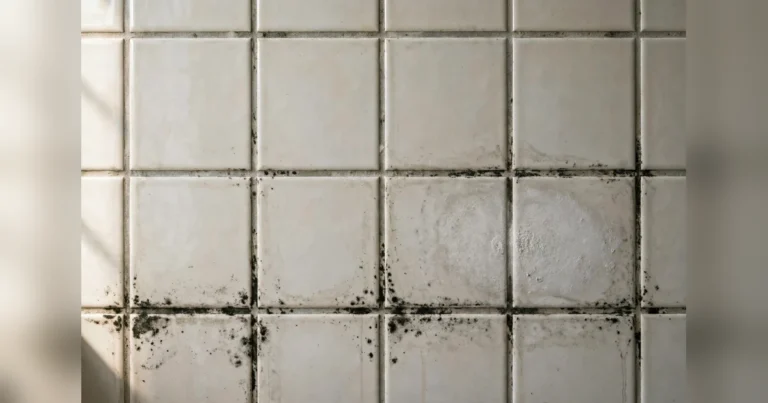
Tile, glass, metal, plastic, porcelain, and stainless steel are the best case. Peroxide sits on the surface, you scrub, you wipe, you dry. That is the job it does well.
Grout and caulk sit in the middle. Healthgrades classifies grout and caulking as porous material that will need replacement. The Spruce, Nature’s Freedom, and Bustmold give grout treatment methods and rate them good to excellent. The practical rule: treat grout you can reach and scrub, seal it only after it is fully dry, and replace caulk if growth is inside the caulk itself. No cleaner fixes caulk from the inside.
Drywall, ceiling tiles, soft furniture, insulation, and carpet are the weak case. Healthline, Healthgrades, and Enviro Decon say peroxide does not work on porous material and porous items need replacement. Bustmold and The Mould Doctor claim penetration into porous material. California’s health department, the CDPH, is clear: porous materials such as drywall, ceiling tiles, drapes, and upholstered furniture absorb water and usually cannot be effectively cleaned of mold, and if they look or smell moldy they should be removed.
| Surface | Can peroxide clean it? | What to do |
|---|---|---|
| Tile, glass, metal, plastic | Yes, best case | Spray 3 percent, scrub, wipe, dry fully |
| Grout you can reach | Split, treat with care | Scrub, dry fully, seal only when dry |
| Caulk with growth inside it | No cleaner fixes it from inside | Remove old caulk, put new caulk |
| Drywall, wood, carpet, insulation | Split, usually no | Scope it or remove the material |
Does it kill black mold?
Guides split. Do not accept a flat yes or a flat no.
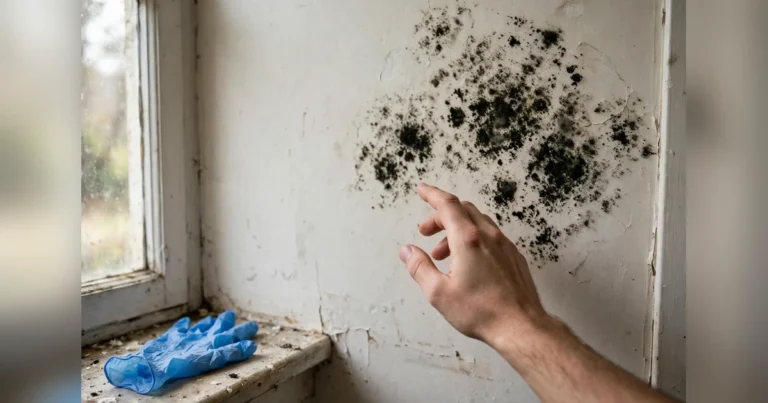
Black is a color, not a species. Many molds look black. The mold people call black mold, Stachybotrys chartarum, is greenish black and slimy, and it grows on material that stays wet a long time. You cannot name it by looking at it. Only a lab sample can name a species, and the name alone does not prove a health risk.
Here is the split, as the guides state it. LookMold says there is no evidence peroxide effectively kills Stachybotrys, and spraying can spread fragments. House Digest cites a 2013 study as finding peroxide can prevent Stachybotrys growth and spore germination, but that citation was not directly verified here. Enviro Decon says peroxide is not recommended for toxic black mold, while Bustmold gives an interim peroxide protocol and calls professional remediation non negotiable for confirmed black mold. Nature’s Freedom says 6 percent works on tile and grout but not on drywall or untreated wood.
The safe rule follows from the split, not from one side. Small, visible, reachable growth on a hard surface can be cleaned. Growth that is large, hidden, or in the material itself is an inspection question, not a stronger spray question. Our Black Mold inspection page explains what a full inspection covers.
Is it better than bleach or vinegar?
Better is the wrong word. Each one has a different weak point, and all three fail without drying.
Authorities disagree about bleach. The EPA says using a biocide like bleach is not recommended as a routine practice during mold cleanup, and dead mold may still cause allergic reactions, so it must also be removed. The CDC gives a bleach option for hard surfaces: 1 cup of household bleach in 1 gallon of water, wash, scrub, rinse, air dry. California’s health department goes further and says, in its own words, “We do not recommend using bleach or products that contain bleach. Bleach can be a respiratory hazard and disinfection is not necessary if you have cleaned the material thoroughly with soap.” Three authorities, three positions on bleach. None of the three names peroxide in the household mold pages checked.
Vinegar is the other home answer, and guides argue about it the same way. Some say vinegar kills spores while bleach only fades stains. Others give vinegar kill percentages with no study named. Those percentages are page claims, not guarantees, and this article does not repeat them as facts.
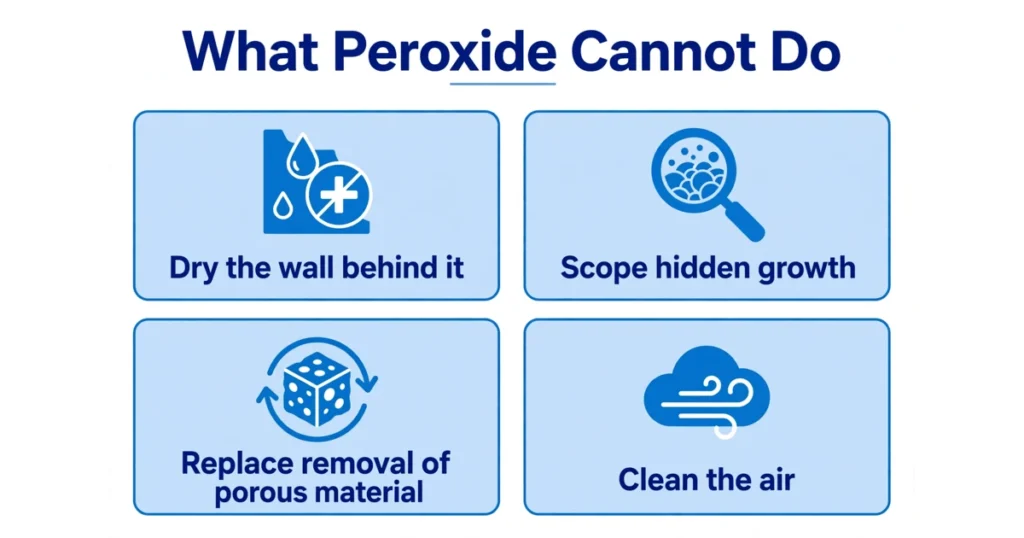
Peroxide sits between the two arguments. It fizzes, it has no strong smell after use, and it breaks down into water and oxygen. But it shares the same limit as bleach and vinegar. None of them dries a wall, scopes hidden growth, or removes porous material. Soap and water, scrubbing, removal, and drying are the steps authorities agree on. The bottle is the smallest part of the job.
Can I mix it with vinegar or bleach?
No. Peroxide and vinegar in one bottle is a chemistry experiment, not a cleaner.
The majority warning is clear: never mix peroxide with vinegar, because the mix can form peracetic acid, a chemical that irritates skin, eyes, and airways. Healthline, Healthgrades, LookMold, Southern Living, House Digest, and GreenCitizen all warn against it. LookMold also warns that mixing peroxide with bleach produces oxygen gas at a dangerous rate. The CDC rule is simpler and covers everything: do not mix cleaning products.
A few pages muddy this. Bustmold sequences peroxide then vinegar as separate steps. One guide says vinegar can also be used with peroxide, with no ratio, sequence, or rinse step. One forum user says to add vinegar to peroxide to strengthen it. Those are contradictions, not instructions. The safe rule is one product at a time, rinse between products, and never mix in one bottle.
Is it safe, and why did my bottle stop working?
At 3 percent, with gloves and ventilation, it is a mild cleaner. An old bottle may be mostly water.
Gloves are universal advice. Goggles and an N95 mask are advised by Healthline, Healthgrades, Nature’s Freedom, and the EPA for mold work generally. If the patch is large or dusty, use more gear, not less.
Spot test before you spray wide. Peroxide can bleach natural fabrics like wool, colored fabrics, dark wood finishes, dyed surfaces, and colored grout. It can harm natural stone such as marble and limestone, and unfinished wood. One expert quoted by Homes and Gardens says the opposite, that peroxide is safe on natural stones, wood, and fabrics without damage. That conflict is why you spot test.
Store it right. Light, heat, and air break peroxide down. Keep it in its dark bottle, in a cool place. One transcript says an opened bottle lasts about 6 months and an unopened bottle 1 to 3 years. A bottle that no longer bubbles is mostly water in a brown bottle. Never store a mixed solution in an airtight jar, because peroxide gives off oxygen gas.
Why does it keep coming back?
Because the water never left. If the patch comes back in days, the spray was never the fix.
One guide claims regrowth typically returns within 30 to 90 days without fixing the moisture source. That is a page claim, not a measurement. Another guide says regrowth after peroxide is slower than after bleach, with no interval given. The Mould Doctor says it will almost certainly reappear unless the cause is addressed. The numbers differ. The message does not.
Use returns as a test. Growth back in days points to a leak, a wet wall, or growth behind the surface. Growth back in weeks points to a habit or ventilation problem, like a fan that never runs, a door that stays shut, or a shower that never dries. Cleaning the same patch five times is not bad luck. It is a moisture source you have not found yet.
Spraying a surface also does not clean the air. One guide says standard spraying will not kill airborne mold spores.
In a Santa Barbara coastal home, this matters in a familiar way. The marine layer brings damp mornings along the coast, and half of Santa Barbara homes were built before 1966, based on Census survey calculations for 2020 to 2024. Older homes, bathrooms with weak fans, and damp crawl spaces are the pattern I see. California guidance gives a useful local checklist: check whether the bathroom fan actually vents outside, and check crawl spaces and basements for dampness. No survey of Santa Barbara customers exists in this research, so this section gives no percentages and no invented quotes.
What do EPA, CDC, and California actually say?
They do not mention peroxide at all. What they do recommend is soap, water, drying, and fixing moisture.
This section corrects a common assumption. The EPA guide, the CDC cleanup pages, and the CDPH mold FAQ were all checked directly. None of the three names hydrogen peroxide in its household mold guidance. Any claim that an authority recommends peroxide would be invention.
The EPA says: moisture control is the key. Fix the water problem, dry damaged areas within 24 to 48 hours, scrub hard surfaces with detergent and water, and dry completely. Porous material such as ceiling tiles and carpet may have to be thrown away. Keep indoor humidity below 60 percent, ideally 30 to 50 percent. Under about 10 square feet, about 3 feet by 3 feet, you can usually handle it yourself. Larger areas, HVAC contamination, or sewage water need a professional.
The CDC says: wash with soap and warm water first, then sanitize hard surfaces with 1 cup of bleach in 1 gallon of water, scrub, rinse, air dry. Never mix bleach with ammonia or any other cleaner. Over 10 square feet, consider a professional. Children should not take part in disaster cleanup work.
California says: find the damp areas, fix the moisture source, dry or replace wet material, and clean or remove moldy material. Glass, plastic, metal, and ceramics can be effectively cleaned. Porous material usually cannot, and should be removed if it looks or smells moldy. Success means the moisture source is fixed, damaged material is cleaned or removed, and what is left is dry and free of visible mold and mold odor.
Peroxide fits inside that advice as a surface cleaning step. It does not replace any of it.
What is new in 2026?
No new government guidance and no hard news story on this exact topic. The latest items are updated guides and one narrow product label.
Searches for 2026 government guidance and news on household peroxide and mold found no new EPA or CDC household guidance page and no hard news story on this exact topic. The 2026 results on other peroxide uses, such as lab studies, dental waterlines, hospital disinfection, crop mold, and toenail fungus, are not household mold cleaning, so they are left out.
What is dated in 2026? Three exact topic guides were published or updated in 2026. Nature’s Freedom, a seller guide, was published June 17, 2026 and updated June 30, 2026, repeating the 3 percent standard and 6 percent for heavy grout. GreenCitizen was updated July 8, 2026, repeating 3 percent, at least 10 minutes, and the warning that peroxide does not eliminate mycotoxins, toxic substances some molds produce. Bustmold shows updated May 2026 in its header and September 21, 2026 in its footer, both dates unresolved. These are guides, not government guidance and not news reporting, and they repeat the same advice as older guides.
One government document is dated in 2026: an EPA pesticide product label dated May 19, 2026, for a product called Oxy-1 RTU, with listed uses including mold and remediation. That label rests on a search snippet only and was not fully verified, and it is a product label, not a new EPA household guide recommending 3 percent peroxide. It must not be cited as one.
The honest freshness line is this: the advice has not changed in 2026, and the authorities have not added peroxide to their household mold guidance.
Frequently asked questions
Does hydrogen peroxide kill mold on walls?
On hard, sealed surfaces, yes, with limits. Inside drywall or behind a wall, no. Growth in the material needs scoping or removal, not a spray.
How long do I leave hydrogen peroxide on mold?
About 10 minutes on a hard surface, and 10 to 15 minutes on grout. Then scrub, wipe, and dry. No study proves kill by time alone.
Can I use hydrogen peroxide on black mold?
Guides split. A small, visible patch on a hard surface can be cleaned. Large, hidden, or in-material growth is an inspection question.
Is hydrogen peroxide better than bleach for mold?
Neither dries a wall or removes porous material. Authorities disagree on bleach, and none of them names peroxide in household mold guidance.
Can I mix hydrogen peroxide with vinegar?
No. The mix can form peracetic acid, an irritant. Use one product at a time, with a rinse in between.
Does hydrogen peroxide kill mold spores in the air?
No. Spraying a surface does not clean the air. Standard spraying will not kill airborne spores.
Why does mold come back after hydrogen peroxide?
Because moisture is still present. Return in days points to a leak or hidden growth. Return in weeks points to a habit or ventilation problem.
Do EPA, CDC, or California recommend hydrogen peroxide for mold?
No. None of the three names it in household mold guidance. They recommend soap and water, drying, and fixing the moisture source.
When is cleaning the wrong first step?
When the growth is big, hidden, recurring, or in the material itself.
Use this checklist before you spray again.
- The patch is larger than about 10 square feet.
- You smell mustiness but cannot see the patch.
- Growth hides behind a wall, under flooring, or in a ceiling.
- The HVAC system may be contaminated.
- Sewage water caused the damage.
- The patch keeps coming back after drying and cleaning.
- Someone in the home has asthma, mold allergy, chronic lung disease, or a weakened immune system.
Spraying the surface does not scope what grows behind it.
Get an inspection before you spend on cleaning, repairs, or products. An inspection answers three questions no bottle can answer. How far does it go? What is wet behind the surface? Where does the water come from? Our Mold Testing page explains how air and surface samples work.
The job is not killing the color. The job is removing the growth and drying the wall.
If you see growth, smell mustiness, or keep cleaning the same patch, get a free estimate and a clear scope first. Call us at (805) 765-0923 or visit our Contact page. We inspect. We find the water. We tell you the scope in plain words, so you spend money on the right fix.