Is Mold on Bathroom Walls Dangerous? The Honest Answer
Is mold on bathroom walls actually dangerous?
Bold direct answer: for most healthy people, a small patch is a nuisance, not an emergency. For sensitive people, and for large or long-running growth, it is a real health problem.
A bathroom wall is the one wall in the house that is wet from both sides: shower steam on the room side, and a pipe, a tile joint or a cold surface on the cavity side. That is why bathroom mold is so stubborn. A bedroom wall dries out and stays dry. A bathroom wall gets wet again every single day.
Bathroom mold is not more poisonous than bedroom mold. It is more stubborn, because the room re-wets itself every single day. The danger does not come from one magic property of bathroom mold. It comes from steady, daily exposure in a small, closed room where you stand close to the wall while you shower, brush your teeth, and breathe in steam.
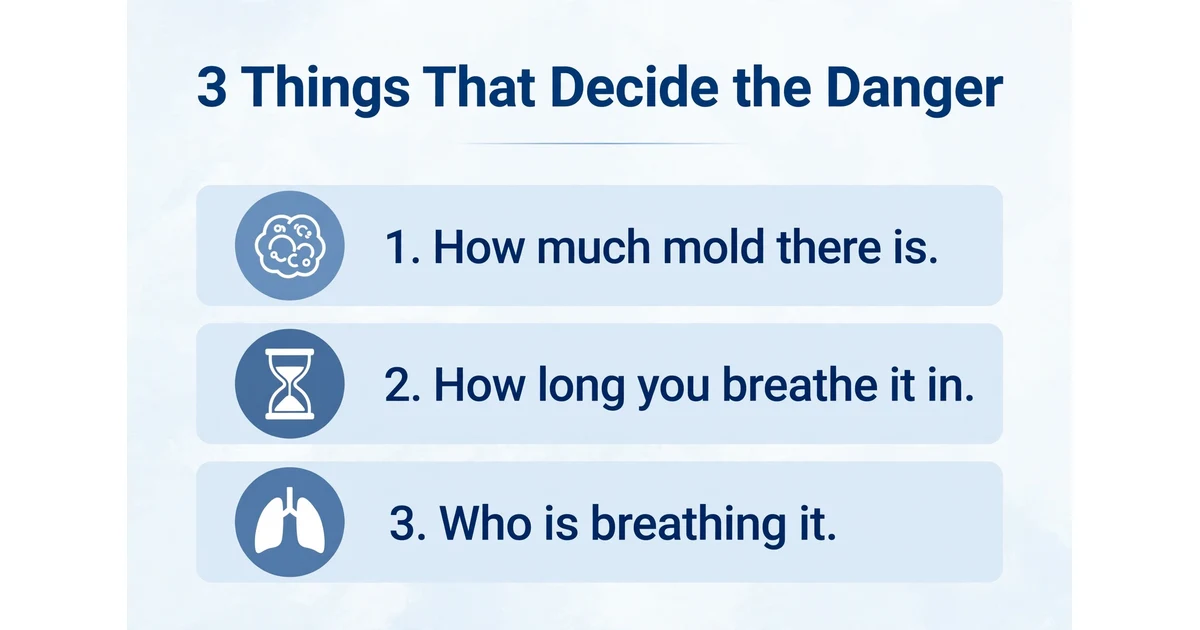
So the honest way to judge your own bathroom is to ask three questions. How big is the growth? How long has it been there? And who in the house breathes that air every day? A coin-sized spot on grout in a house full of healthy adults is a cleaning job. A wall that has been damp for months in a house with an asthmatic child is a different story.
What does bathroom mold do to your health?
Bold direct answer: mostly allergy-type and irritation symptoms. Serious lung infection is rare and mostly limited to people with weak immune systems or chronic lung disease.
The CDC’s position is plain: exposure to damp and moldy indoor spaces may cause a variety of health effects, or none at all. That sentence matters, because most of the internet skips the “or none at all” half.
| Who you are | What mold exposure usually does |
|---|---|
| Healthy adult, no allergies | Often nothing. Sometimes a stuffy nose, itchy eyes, or a cough that comes and goes. |
| Person with mold allergies | Sneezing, runny or blocked nose, itchy or watery eyes, skin rash, throat irritation. |
| Person with asthma | Mold can trigger attacks: more coughing, wheezing, chest tightness, shortness of breath. |
| Child, older adult, or person with chronic lung disease | Higher risk of lasting respiratory symptoms and infections. |
| Person with a weak immune system | Highest risk. Lung infections are possible, and cleanup should be left to someone else. |
The World Health Organization reviewed the research on damp buildings and found that people living in damp or moldy buildings have up to a 75 percent greater risk of respiratory symptoms and asthma than people in dry buildings. Read that number carefully. It is about damp buildings in general, not about one bathroom wall. It still tells you the direction of the evidence: dampness plus mold, over time, hurts lungs, especially lungs that are already sensitive.
If you have symptoms, talk to a doctor about them. A mold inspector inspects buildings. A doctor diagnoses people. Keep those two jobs separate.
Is black mold on a bathroom wall more dangerous than other mold?
Bold direct answer: no. Color does not measure danger, and most dark bathroom mold is not the famous “toxic black mold” at all.
The mold people fear has a Latin name: Stachybotrys chartarum. It can produce substances called mycotoxins under some conditions. But three facts take the fear down to size.
First, Stachybotrys needs sustained, soaking wetness, not just a steamy bathroom. It grows on materials with a lot of cellulose in them, like the paper face of drywall and ceiling tiles, after weeks of water damage. A steamy shower alone rarely gives it what it needs.
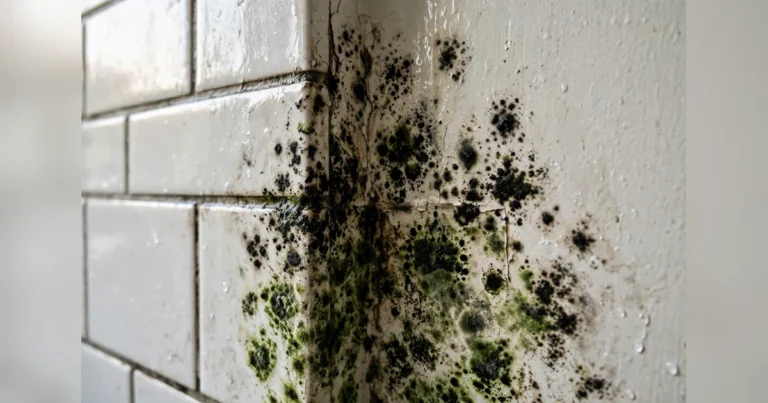
Second, most dark mold in a bathroom is not Stachybotrys. Cladosporium, Aspergillus, and Penicillium all come in dark colors too, and they are far more common in bathrooms. You cannot tell them apart by looking. Only lab testing names a species, and the CDC says that testing is usually a waste of money, because the action is the same whatever the name comes back as.
Third, the CDC says there is not enough evidence that black mold causes unique or more severe health effects than other indoor molds. There is no proven link between Stachybotrys and rare conditions like memory loss. Websites that list nosebleeds, memory loss, and nerve damage as established black mold symptoms are selling fear, not science.
Nobody in your house needs to know the mold’s Latin name. The CDC’s answer is the same for every species: find the water, fix it, remove the growth.
Is it safe to shower when there is mold in the bathroom?
Bold direct answer: light surface mildew on tile, yes. Spreading growth or a strong musty smell, pause and fix it first, especially if anyone in the house has asthma.
This is the question almost every competitor page dodges, so here is the plain version.
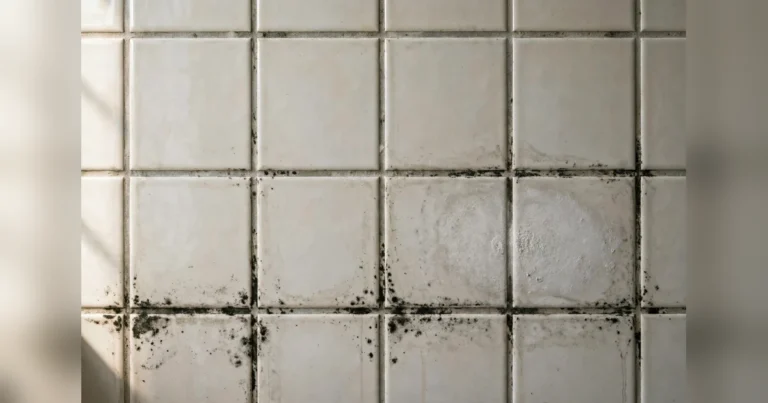
A thin film on grout or a few spots on the shower curtain is a cleaning job, and showering next to it will not poison a healthy adult. The spores are already in the air of every home, indoors and out. A small patch adds a small amount.
Stop and fix it first when any of these are true:
- The growth is spreading across the wall, not sitting in one small spot.
- The bathroom smells strongly musty even after cleaning.
- The wall feels soft, or paint is bubbling near the growth.
- Anyone in the house has asthma, allergies, or a weak immune system and their symptoms flare in that bathroom.
One more rule for the shower itself: never scrub a large patch of mold while you stand under the shower with the water running. Scrubbing throws spores into the air, and steam carries them straight to your face. Clean with the fan on, the window open if you have one, gloves on, and a mask on if the patch is bigger than your hand.
What if the mold is on the wall, not the grout?
Bold direct answer: then it is usually a water problem, not a cleaning problem, and scrubbing alone will not fix it.
Grout mold is a cleaning job. Wall mold is a water job. Scrubbing treats the first and hides the second.
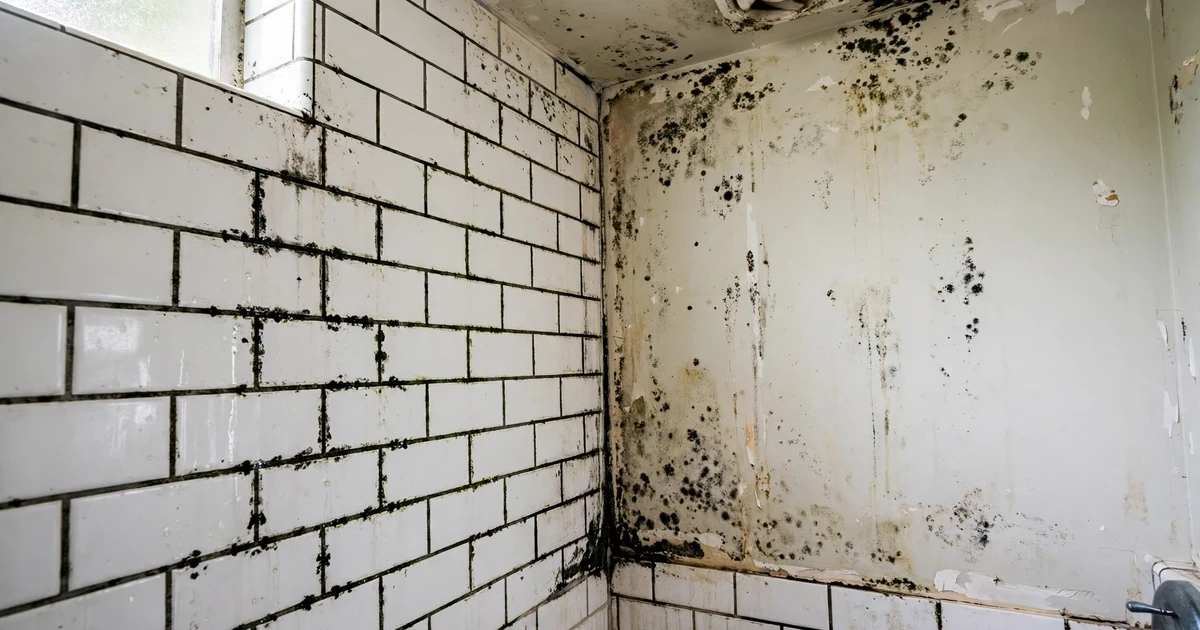
Grout and caulk sit on the surface. They get wet, they grow mold, you scrub them, they dry. A wall is different. Standard drywall is faced with paper, and paper is mold food. Once mold gets into that paper, or into the cavity behind the wall, no amount of surface scrubbing reaches it. The wall keeps feeding the growth from behind, and the patch keeps coming back.
If the patch comes back in the same spot after you cleaned it, you did not fail at cleaning. You cleaned the symptom and left the source.
| Grout mold | Wall mold | |
|---|---|---|
| Where it lives | On the surface of grout and caulk | On and inside the drywall |
| What feeds it | Soap scum and standing water on the surface | A leak, condensation, or wet cavity behind the wall |
| What fixes it | Scrubbing, drying, resealing grout | Finding and fixing the water, then cleaning or replacing the wall material |
| When it returns | When the surface stays wet | When the water behind the wall is still there |
How do you know if the mold is behind the wall?
Bold direct answer: look for the signs the wall leaves when water is working behind it. One sign is a clue. Two or more mean the problem is probably inside the wall.
Walk your bathroom slowly and check for these:
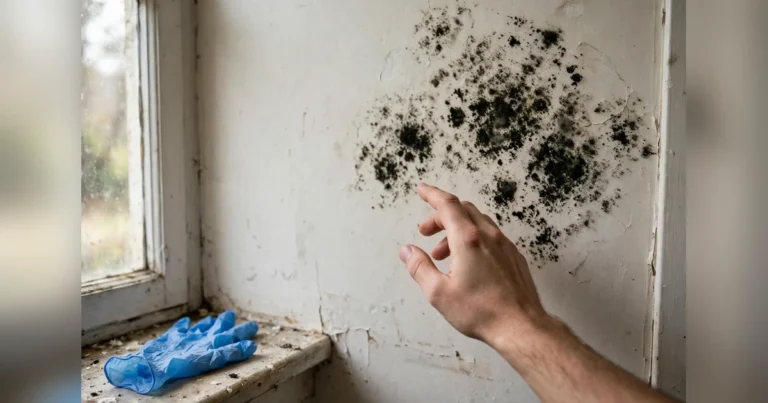
- Paint or wallpaper bubbling, peeling, or pulling away from the wall.
- A faint tide line or yellowish stain on the wall, especially near the base.
- A baseboard that has pulled away from the wall or swelled.
- Drywall that feels soft or spongy when you press it.
- Nail heads rusting through the paint.
- A musty smell that comes back within days of cleaning, even when you cannot see any mold.
- A patch that returns in the exact same spot after scrubbing.
A wall that feels soft when you press it has already stopped being a cleaning question and started being a repair question. Soft drywall means the paper and the core have been wet long enough to break down, and cleaning the surface will not put strength back into it.
There is one more check that costs nothing and tells you more than guessing the species. The most useful mold test in a bathroom costs nothing: leave the room for an hour and notice whether your nose, eyes or cough settle, then notice whether they return when you walk back in. Symptoms that ease away from the bathroom and return inside it point at the bathroom. That pattern is worth more than a lab report naming a species, and it is the first thing worth telling a doctor or an inspector.
How does an inspector actually check a wall? With a moisture meter, reading the suspect wall against a dry wall in the same house. A wet reading where the rest of the house reads dry means water is arriving there from somewhere, and the next job is finding where. No inspection can see through every wall, and an honest report says clearly what was accessible and what was not.
Is bathroom mold dangerous for children or during pregnancy?
Bold direct answer: children with asthma or allergies face a real risk, and they deserve faster action. For pregnancy, the honest evidence is calmer than the fear content online.
Children breathe more air per pound of body weight than adults, and their lungs are still developing. Research reviewed by the WHO links damp and moldy homes to asthma development in children, not just asthma attacks in children who already have it. If a child in the house coughs or wheezes more at home than elsewhere, or a child’s asthma keeps flaring, the bathroom deserves a hard look before anything else.
For pregnancy, the internet is full of scary claims, so here is the evidence-based position from MotherToBaby, a service that reviews research on exposures in pregnancy. It is not known whether mold exposure makes pregnancy harder to achieve, increases miscarriage, or increases birth defects. Animal studies showed birth defects only when mold was eaten in large quantities. There is no proven risk in human pregnancy from airborne mold. Some studies link certain mycotoxins to low birth weight, and other studies do not. That is the whole honest picture: uncertain, not proven dangerous, and not proven safe either.
What is not uncertain is the practical advice. Pregnant women, infants, older adults, and people with weak immune systems should not do large-area mold cleanup themselves. Someone else should handle it, with the room ventilated and the moisture fixed at the same time.
What about the pink or orange stuff on the wall?
Bold direct answer: the pink stuff is usually not mold at all, and the orange stuff is usually a surface organism that tells you the caulk is soaking up water.
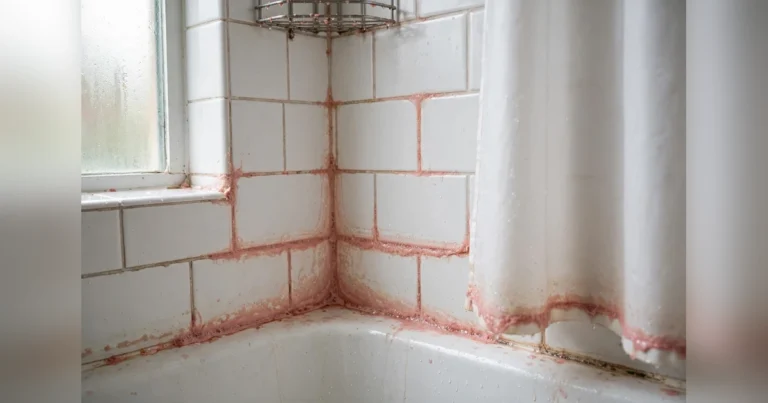
The pink stuff on the wall is usually not mold at all. It is a bacterium that likes the same wet corners, and it answers to soap, not to mold killer. Its name is Serratia marcescens. It grows as pink rings around drains, on shower doors, and on grout near drains, feeding on soap residue. For most healthy people it is harmless. It can cause urinary tract, respiratory, and wound infections in people with weak immune systems, so it still deserves cleaning, but it is a soap-and-disinfectant job, not a mold job.
Orange growth is usually Aureobasidium. It starts rust-orange and darkens to brown-black with age, and it shows up near aging caulk and drain edges. It is a surface organism, easy to clean, and its real message is that the caulk is absorbing water and needs replacing.
If you treat pink or orange growth with mold killer and it keeps coming back, you are treating the wrong organism or the wrong cause. Clean the soap residue, dry the surface, and replace caulk that stays wet.
When does wall mold stop being a DIY job?
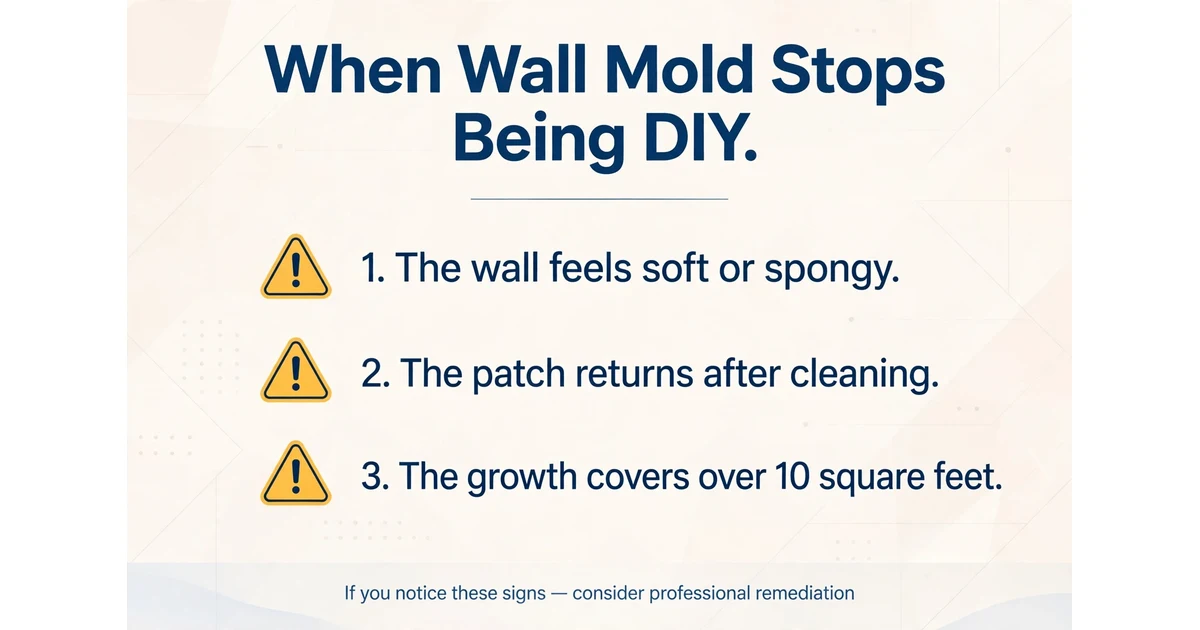
Bold direct answer: when the wall itself is damaged, when the growth keeps returning, or when it covers more than about 10 square feet. At that point, stop scrubbing and get the source mapped.
The EPA‘s rule is simple: under about 10 square feet, roughly a 3 foot by 3 foot patch, a careful homeowner can usually handle it. Over that, or with extensive water damage, bring in a professional. Use this version for walls, which is stricter in the right places:
| DIY it | Stop and call a professional |
|---|---|
| Small surface patch on grout or tile | Growth over about 10 square feet |
| Wall is firm, paint is flat, no smell after cleaning | Drywall is soft, sagging, or stained through |
| Patch stays gone for a month after cleaning | Patch returns within 30 days of cleaning |
| No one in the house has asthma or a weak immune system | Musty smell with no visible mold at all |
| You know where the water came from and it is fixed | A leak, burst pipe, or roof leak is still unresolved |
One more warning, plainly: if anyone in the house has bleeding or severe breathing difficulty, leave the room and call a doctor before going back in. That is rare, and it is not a normal mold symptom, which is exactly why it needs a doctor fast.
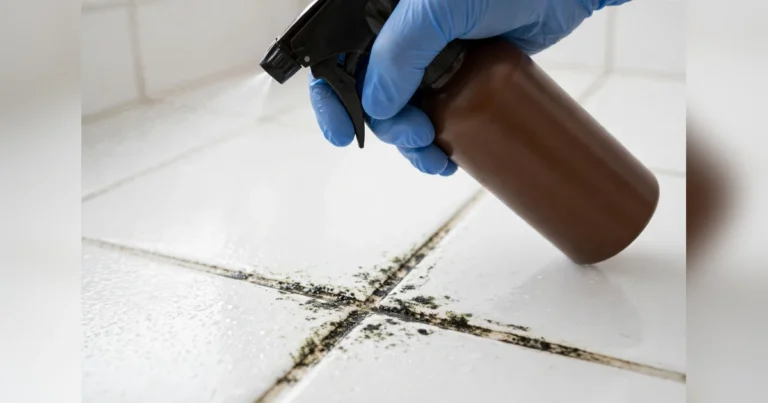
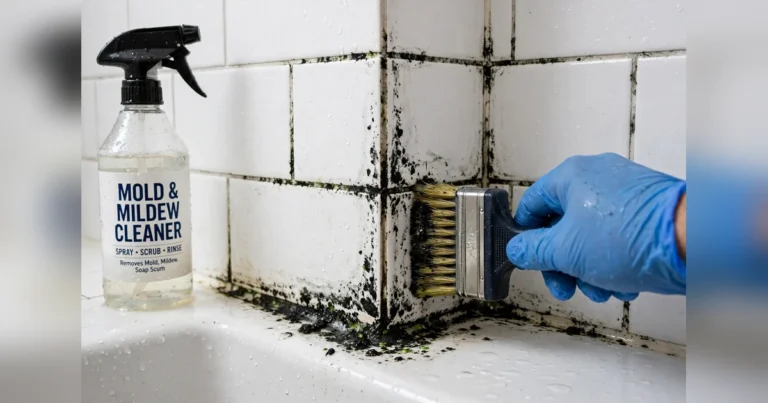
For the DIY case, the safe method is short: ventilate, wear gloves, goggles, and an N95 mask (not a cloth mask), spray undiluted white vinegar or 3 percent hydrogen peroxide, let it sit for an hour, scrub gently, wipe, and dry completely. Gentle matters. Hard scrubbing throws spores into the air. On porous surfaces like grout and drywall, skip bleach. Bleach sanitizes the surface, but its water carries living spores deeper into the material, which is why a bleached patch so often comes back. Vinegar and hydrogen peroxide reach deeper. And never mix bleach with ammonia or any other cleaner. That combination makes toxic gas.
Paint does not seal mold in. It seals the evidence in and lets the water keep working behind it. The same goes for caulk layered over old caulk. Clean, dry, fix the water, and only then repaint or reseal.
How do you stop bathroom wall mold coming back?
Bold direct answer: you stop it by taking away what it needs, every day, not by cleaning harder once.
Mold needs three things: water, food, and still air. A bathroom hands it all three after every shower. Prevention is a rhythm, not a single fix.
Daily:
- Squeegee the shower walls and glass after use. Thirty seconds, and it removes the water mold needs.
- Run the fan during the shower and for 15 to 20 minutes after. A bathroom fan is not a smell fan. It is the room’s drying machine, and 15 to 20 minutes after the shower is the dose that matters.
- Leave the bathroom door open after showering so damp air can escape.
Weekly:
- Wipe grout, caulk, and corners with a vinegar spray.
- Wash the shower curtain or liner so soap residue does not build into biofilm.
Monthly:
- Clean the exhaust fan grille. A dust-caked grille moves almost no air, and a fan that moves no air is decoration.
- Look under the sink and behind the toilet for drips, and check the caulk lines for cracks or gaps.
Yearly:
- Reseal cement grout if it is unsealed or worn.
- Replace silicone caulk that is discolored, cracked, or pulling away. Caulk loses its mold resistance within 12 to 24 months as soap scum builds on it.
- When renovating, use mold-resistant drywall and bathroom paint rated for high-moisture rooms, and 100 percent silicone caulk at every tile-to-tub joint.
If your fan vents into the attic instead of outside, fix that first. You are not removing moisture then. You are moving it to a hidden space where it grows attic mold instead. And if the fan is older than ten years or too weak for the room, replace it. A modern humidity-sensing fan that runs itself solves the human-memory problem entirely.
Does an air purifier fix bathroom mold?
Bold direct answer: no. It can catch spores in the air, but it cannot fix the moisture or the growth on the wall.
A HEPA air purifier may help the air feel better, but it does nothing about the water source or the colony on the wall. Fix the water and remove the growth, or the purifier is filtering a problem that is still growing.
Mold Inspection Santa Barbara offers a free estimate and 24-hour service in Santa Barbara, California. Call (805) 765-0923 to book an inspection-only visit. We inspect and test. We do not sell remediation, so the findings stay independent.