Cladosporium on Your Wall: What It Is, Whether It Is Dangerous, and How to Get Rid of It for Good
Short answer
Cladosporium on your wall is a common allergenic mold that grows where a wall stays damp, and it is rarely dangerous for a healthy adult in a small patch, but it should never be ignored. The patch you can see is almost never the whole story. Find why that wall is wet, fix the water, and then clean or remove the growth the right way for the wall material. Scrub the stain while the wall stays damp, and it will come back.
Quick facts
- What it is: Cladosporium, a darkly pigmented mold genus. The CDC lists Cladosporium, Penicillium, and Aspergillus as the most common indoor molds.
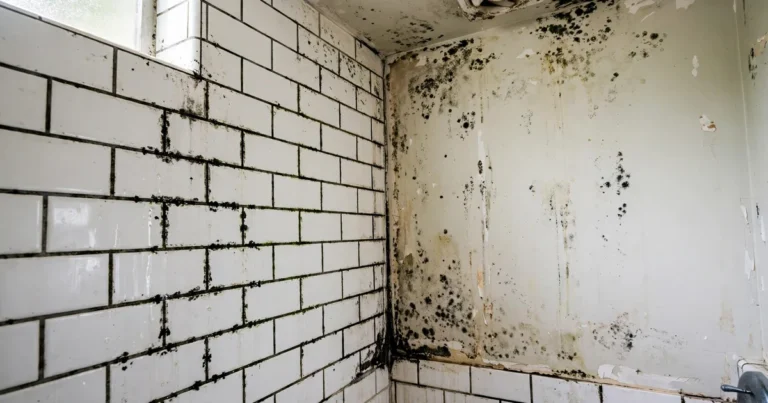
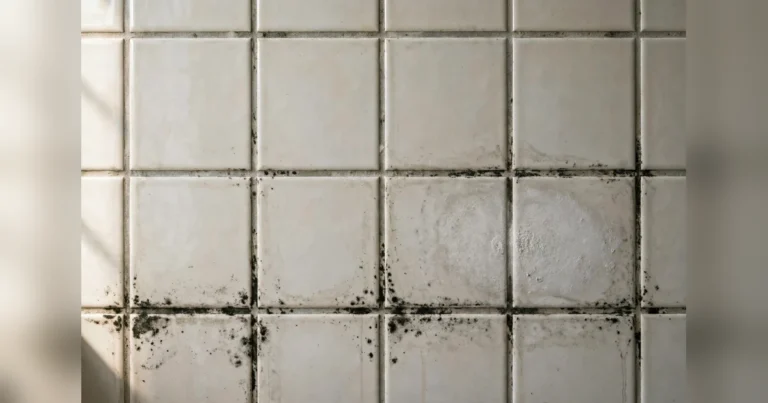
- What it looks like: Olive green to dark brown or nearly black patches, dry and powdery, velvety, or suede-like.
- Danger level: Allergenic, not toxigenic at normal home levels. It triggers allergy and asthma symptoms.
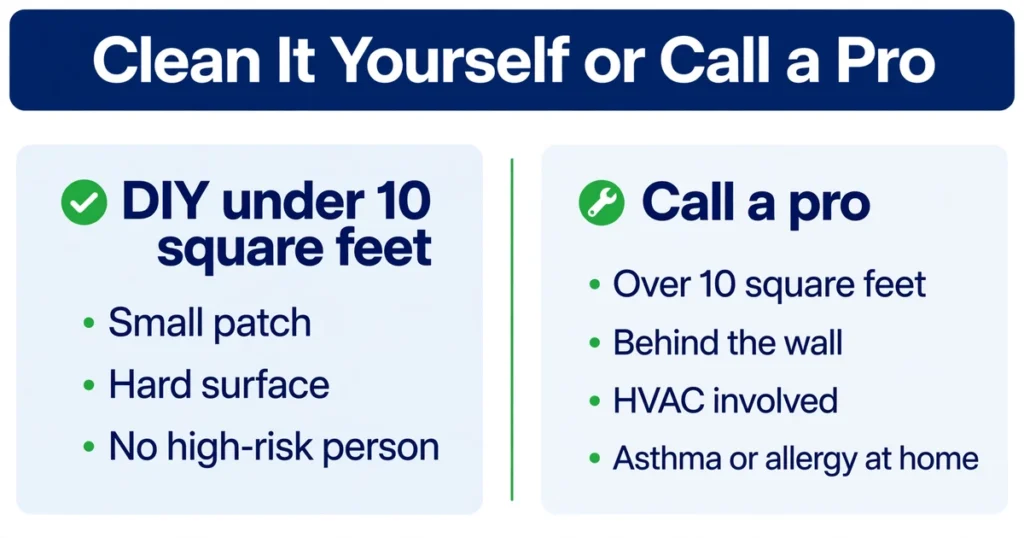
- DIY limit: Under 10 square feet, on a hard or semi-porous surface, in a home with no high-risk person.
- First step, always: Find the water. Cleaning comes second.
- Test rule: A test result means little without an outdoor sample taken the same day.
Is the dark patch on my wall Cladosporium?
You cannot know from looking alone, and anyone who tells you they can is guessing. Cladosporium, Alternaria, Aspergillus, Penicillium, and Stachybotrys can all look dark olive, brown, or black to the naked eye. Medical News Today puts it plainly: it is almost impossible to identify Cladosporium visually.
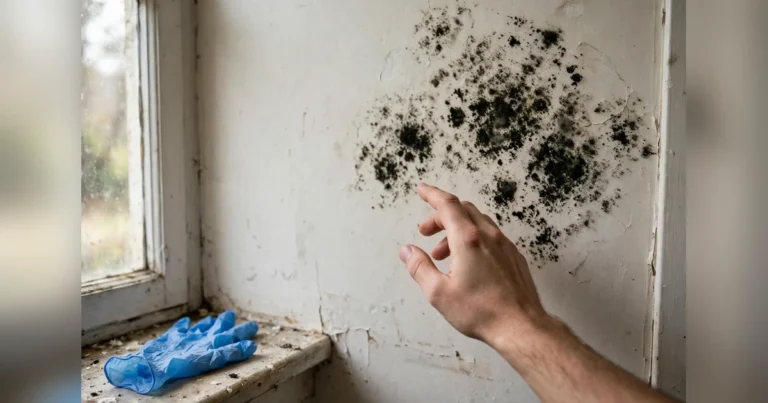
Texture gives clues, not a diagnosis. Cladosporium patches are usually dry, powdery, velvety, or suede-like, often in clusters or streaks spreading from a central point. On porous surfaces the growth may show more as staining than as fuzz. Stachybotrys, the mold people call black mold, is usually slimy or wet while actively growing. The only reliable species confirmation is lab testing, either an air sample or a surface swab or tape lift. That matters when the answer changes what you do, for example in a rental disagreement, when growth keeps returning, or when someone in the home has asthma. For a small patch on a bathroom wall with a known leak behind it, most people do not need a lab to tell them to fix the leak and clean the wall.
Older guides say the genus has more than 40 species. Newer taxonomy counts hundreds. Both numbers come from real revisions of the science. The three species you will hear most about indoors are C. cladosporioides, the most common worldwide and dominant in outdoor air, C. herbarum, a major outdoor allergen, and C. sphaerospermum, the species most often recovered from indoor surface samples.
Why is it growing on this wall?
It is growing there because that wall stays damp long enough, and the dampness almost always has one of three sources. Cladosporium on a wall is often the second mold to arrive, not the first. Indoors it commonly follows primary colonizers such as Penicillium, Aspergillus versicolor, or Wallemia on walls, which means the visible patch may sit on top of an older colony underneath.
| Wall location | Most likely water source | Check first |
|---|---|---|
| Cold exterior wall or corner | Condensation | Insulation gaps, indoor humidity, furniture pushed tight against the wall |
| Wall behind a bathroom or kitchen | Plumbing leak inside the cavity | Supply lines, drain joints, shower valves, under-sink cabinets on the other side |
| Wall near the foundation or roofline | Exterior intrusion | Gutters, downspouts, grading, flashing, roof leaks |
| Wall under or around a window | Failed seal | Caulk, weatherstripping, window flashing, condensation on the frame |
Cladosporium does not need a flood. A cold corner and 55% humidity are enough. The species C. sphaerospermum can colonize at a water activity as low as 0.82, lower than Stachybotrys needs, and active growth is supported above 55% relative humidity sustained for 24 to 48 hours. That is why a wall can grow mold even when nobody ever saw water on it.
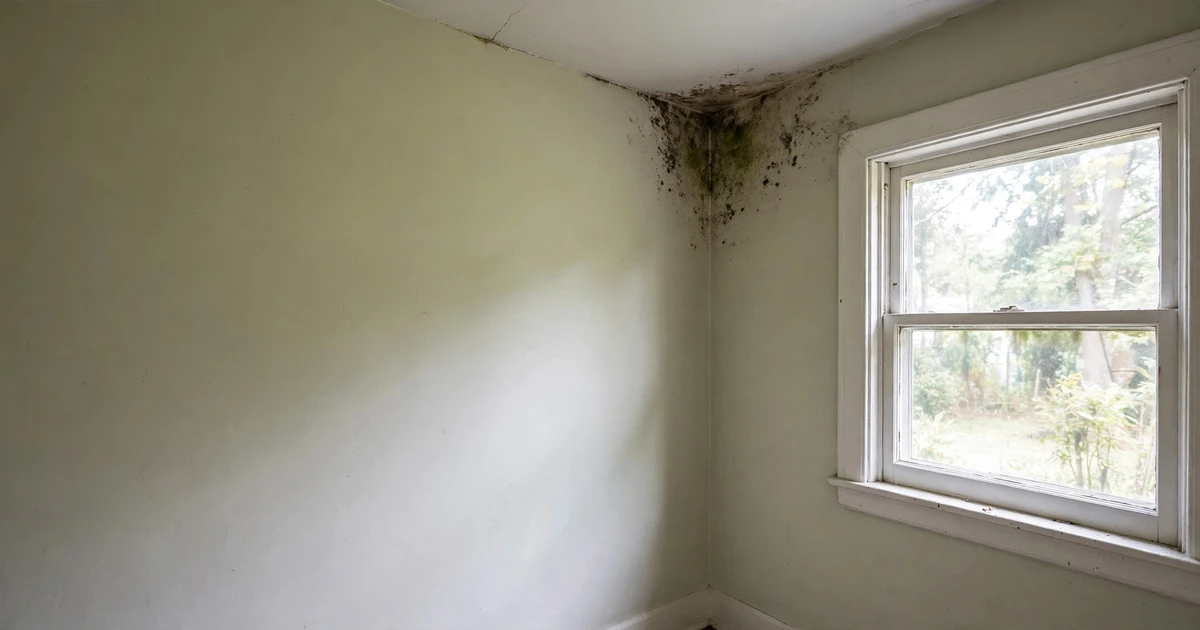
Cold walls grow this mold in winter, not just damp rooms in summer. C. herbarum grows best at 18 to 28 degrees Celsius but can keep growing below freezing, down to minus 6 and reportedly minus 10 in lab reports. A cold wall, a window frame, or an unheated room can grow Cladosporium in midwinter while the rest of the house looks dry.
Is it on the wall or inside the wall?
This is the highest-stakes wall question, and the answer decides whether cleaning is enough or material must come out. The patch you see is the smallest part of the colony. Growth on the back side of drywall, inside insulation, or on framing can be far larger than the stain on the surface.
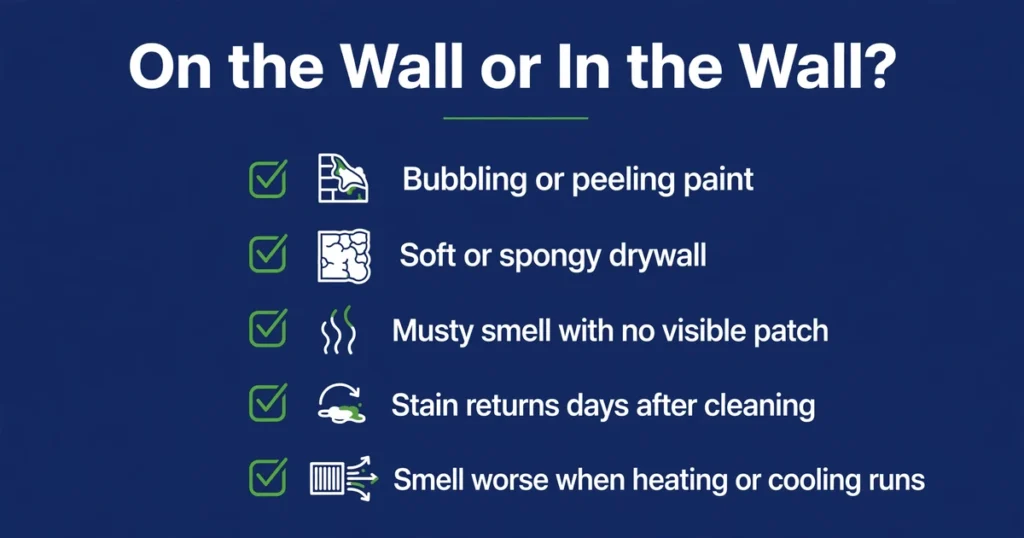
A wall can look dry and still be wet enough for Cladosporium. Signs it has gone behind the surface:
- Paint bubbling, peeling, or blistering over the area
- Drywall that feels soft, spongy, or bowed when pressed
- A musty smell with no visible patch, or a smell that stays after cleaning
- A stain that returns days after a good cleaning
- Growth along the bottom of the wall after a leak
- A musty smell that gets worse when the heating or cooling runs points to the ducts, not the wall.
If you see two or more of these signs, stop scrubbing the surface. The problem is behind it, and surface cleaning will not reach it. That is where a moisture meter reading and, in many cases, a professional inspection earn their cost. A reading below 15% moisture before closing a wall back up is the check professionals use to confirm the wall is actually dry.
Is Cladosporium on a wall dangerous?
For most healthy adults, a small patch is a low concern. For children, people with asthma or mold allergy, older adults, and people with weak immune systems, the same patch deserves faster action. The CDC position is honest and worth quoting in plain words: exposure to damp and moldy environments may cause a variety of health effects, or none at all.
Cladosporium harms people almost entirely through allergy, not through toxins. Most indoor Cladosporium species do not produce mycotoxins at levels that matter clinically at home. That is the difference between an allergenic mold and a toxigenic one, and it is why panic is the wrong response and ignoring it is also the wrong response.
In severely immunocompromised people, a rare invasive infection called phaeohyphomycosis has been reported, but it is extremely rare in healthy people. For pregnancy, the honest line is that there is no established Cladosporium-specific pregnancy risk. General guidance still applies: a pregnant person should not be the one doing the cleanup, and the room should be cleaned before it is used normally again.
What are the symptoms of Cladosporium exposure?
The usual symptoms look like allergy or asthma: sneezing, a runny or stuffy nose, postnasal drip, itchy or watery eyes, coughing, wheezing, chest tightness, and shortness of breath. Skin can react too, with dry skin, hives, or a rash. Long-term exposure can lead to chronic sinus inflammation, with long-term congestion, postnasal drip, and recurring sinus headaches. In some cases fungal debris and blockages in the sinuses need surgery.
Seek emergency care for severe asthma signs: severe shortness of breath, difficulty breathing, chest tightness or pain, or symptoms that do not respond to a fast-acting inhaler.
About 8% of the general population is sensitized to Cladosporium, and 5.8% to 20% of people with asthma are sensitized, according to figures tracing back to Denning and colleagues in the European Respiratory Journal in 2006, repeated in a 2026 allergy guide update. Clinic studies in different countries put Cladosporium sensitization at roughly 5% to 11% of allergy patients. For scale, the CDC reported in 2025 that 8.5% of American adults and 6.3% of children currently have asthma. Those are all-asthma numbers, not Cladosporium numbers, but they show how large the group is that feels wall mold first.
Fresh 2026 reporting backs up the seasonal pattern. Healio reported on October 7, 2026 that outdoor molds are the second major fall trigger, rising as leaves decompose, especially on windy days, while indoor allergen load climbs as windows close. An allergy clinic in Rochester reported on October 19, 2026 that leaf-pile mold is the fall trigger people miss, and that raking and mulching release high concentrations of spores.
Cladosporium vs black mold: how can you tell?
You cannot tell reliably by color, and color is the mistake most people make. Both can look black. Texture and moisture need are better clues, and lab testing is the only confirmation.
| Feature | Cladosporium | Stachybotrys (black mold) |
|---|---|---|
| Color | Olive green, dark brown, near black | Dark greenish black |
| Texture | Dry, powdery, velvety, suede-like | Slimy or wet while actively growing |
| Moisture need | Moderate or fluctuating humidity | Sustained saturation on cellulose such as drywall, wood, or paper |
| Speed | Fast, establishes in 24 to 48 hours on damp material | Slow, 8 to 12 days to germinate |
| Main risk | Allergy and asthma trigger | Mycotoxins, plus allergy |
If the patch is dry and powdery on a wall that gets damp now and then, Cladosporium is the likelier candidate. If it is slimy on drywall that stayed soaked for a long time, Stachybotrys is likelier. Either way, the cleanup rule is the same: remove the moisture, then remove the growth. Do not let the name of the mold decide whether you act.
Is the white powder on my wall mold or salt?
White powder on a wall is often salt, not mold. The salt deposits are called efflorescence. They form when water moves through masonry and leaves mineral salts behind as it dries. Mistaking salt for mold leads to bleaching a wall that was never a mold problem, and mistaking mold for salt leads to ignoring a real one.
Simple tests help tell them apart. Salt wipes off and leaves a bare surface beneath, while mold smears and stains. Salt dissolves in water spray, mold does not. Salt shows no color change with bleach, mold usually lightens. Salt is odorless, mold smells musty and earthy. Over 30 days, salt stays the same size and mold grows.
If the deposit passes the salt tests, the wall still deserves attention, because water is moving through it. But the fix is a water and masonry question, not a mold cleanup.
Should I test my wall for Cladosporium?
Usually no, and the CDC says so directly: the CDC does not recommend routine mold testing. Health effects differ from person to person, so a sample cannot say whether someone will get sick. There is no set standard for an acceptable quantity of mold in a home. Good sampling costs real money. And the rule underneath it all is simple: no matter what type of mold is present, you need to remove it.
Testing is worth it in four situations: visual identification is disputed, for example in a rental disagreement or an insurance claim; growth may be distributed through the HVAC system, with elevated airborne counts through the home and no visible patch to explain them; you need species confirmation because someone in the home has severe asthma or a weak immune system; or post-remediation clearance, to confirm the job is actually finished.
Mail-in DIY kits can identify a species from a swab, but they give no air-quality context. Air sampling shows what is actually floating in the room, and it must be read against an outdoor baseline taken the same day. Surface swabs and tape lifts confirm species. A moisture meter finds hidden moisture that eyes cannot see.
What does my Cladosporium test result actually mean?
Your test result means nothing without the outdoor number from the same day. Indoor air always contains some mold spores, because outdoor spores come in through doors, windows, vents, and HVAC systems, and ride in on clothing, shoes, bags, and pets. An indoor number only means something when compared with outdoor air measured at the same time.
Three numbers help make sense of a report. First, 3,000 spores per cubic meter is the figure commonly cited as the threshold for clinical significance for Cladosporium, from the microbiologist Dr. Jackson Kung’u and repeated in later reviews. Individuals can react at lower concentrations, so it is a guide, not a safety line. Second, about 1,000 spores per cubic meter of total fungi is commonly cited as an environmental normal ceiling. Above it, investigators start looking for an indoor source. Third, outdoor summer peaks of 2,000 to 50,000 spores per cubic meter are normal for Cladosporium outdoors, and very low winter counts are normal too.
Recorded 2026 counts show how this works in practice. A National Allergy Bureau station in Las Vegas reported on September 25, 2026 that overall mold was rated low, yet Cladosporium measured 739 spores per cubic meter, still ahead of Penicillium and Aspergillus at 179 and Alternaria at 70. Canton, Ohio public health reported on October 16, 2026 a total mold count of 5,320 spores per cubic meter, of which Cladosporium was 1,740 and Alternaria only 10. In both cases Cladosporium was the dominant identified mold, in different seasons and different cities.
The honest tension to hold is this: testing is useful for species confirmation, HVAC suspicion, and clearance, but no test result can declare a home safe or unsafe. There is no EPA or CDC safe-versus-unsafe standard, and Health Canada has taken the same position, that air-test results cannot be used to assess occupant health risk. Clean visible and concealed mold regardless of species.
Can I clean Cladosporium off my wall myself?
Yes, if the patch is under 10 square feet, on a hard or semi-porous surface, and nobody in the home is in a high-risk group. That 10 square foot rule comes from EPA guidance and is the line every serious guide uses. Bigger than that, or in the HVAC system, or inside the wall, or recurring after a proper cleaning, means a professional.
| Wall material | Clean or remove |
|---|---|
| Painted wall, sound paint | Clean, then repaint only after fully dry |
| Wallpaper | Usually remove, mold grows on the paste and the paper behind it |
| Bare or unpainted drywall, penetrated | Cut out and dispose, it cannot be cleaned through |
| Plaster, sound and solid | Clean, plaster can usually be saved |
| Concrete block | Clean the surface, but check the cavity behind it |
| Wood framing, structural | Professional assessment if growth is deep or the wood is soft |
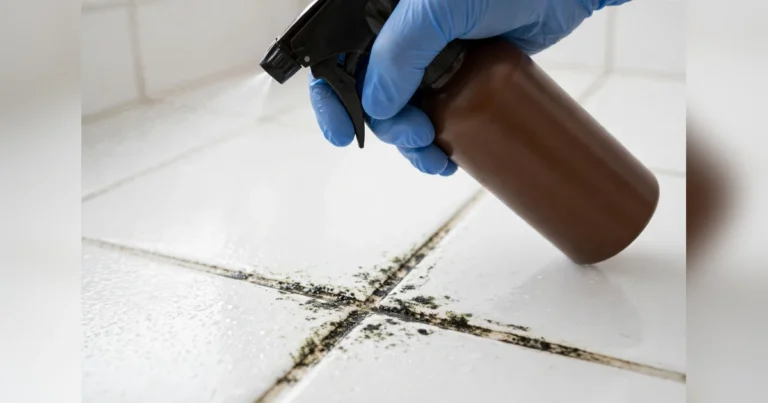
Steps for a small job, in order. First, fix the moisture. No cleaning works on a wall that is still getting wet. Second, protect yourself: N95 mask at minimum, nitrile gloves, goggles. Standard dust masks do not stop these spores. Third, mist the patch lightly before scrubbing so spores do not fly everywhere, turn off the HVAC serving that room, and cover vents and doorways with plastic sheeting. Fourth, scrub hard surfaces with detergent and water, or 3% hydrogen peroxide. On semi-porous painted surfaces, detergent plus an antimicrobial cleaner works. Fifth, HEPA vacuum the area after scrubbing, including nearby dust and soft furnishings. Sixth, dry fully with fans and a dehumidifier, and verify moisture below 15% with a meter before closing anything up. Seventh, bag rags and debris, double-bagged, and dispose of them.
On bleach, the CDC rule is clear: on hard surfaces, no more than 1 cup of household laundry bleach in 1 gallon of water. Never mix bleach with ammonia or other cleaners, because the gas it makes is poisonous. Bleach does not work on porous surfaces. It kills what is on the surface while the moisture underneath keeps feeding the problem, and in an enclosed space the fumes are a problem of their own. Detergent and peroxide do the same job on hard surfaces without that risk.
Can I paint over it?
No. Painting over wall mold seals the stain in and the problem behind it. Paint traps moisture, hides growth that continues underneath, and guarantees the stain bleeds back through. EPA guidance is direct on this point: clean and dry before caulk or paint.
The right order is fix the water, clean or remove the growth, dry the wall completely, verify it with a meter, and only then prime and paint. If a stain still shows after cleaning and full drying, a stain-blocking primer is fine, but only on a wall that is verified dry. Paint is the last step, never the fix.
Can I sleep in the room?
It depends on who is sleeping there and how much growth is active. For a healthy adult, a small patch that is being cleaned is a low concern, and the room can be used normally once cleaning is done and the room is dry.
Do not sleep in a room with active visible growth if anyone sleeping there has asthma, mold allergy, a weak immune system, or chronic lung disease, and do not let a child or an infant sleep there either. In those cases, clean the room first, or keep the person out of it until a professional has cleaned it. And never do the cleaning yourself if you are in one of those groups. Let someone else do it, or hire it out.
When do I need a professional?
Call a professional when any one of these is true. The patch is over 10 square feet. There are behind-wall signs: soft drywall, bubbling paint, smell with no visible patch, or a stain that returns days after cleaning. The HVAC system is spreading spores through the home. Someone in the home has asthma, mold allergy, weak immunity, or chronic lung disease. The growth came back after a proper cleaning with the moisture supposedly fixed. The wall material is structural wood, or the framing itself is soft. Or you need documentation for a landlord, an insurer, or a sale.
A professional inspection should find the moisture source with meters and, when needed, lab sampling, and give you a scope for remediation that is separate from the company doing the cleanup. That separation matters. An inspector who also sells the cleanup has a reason to find a bigger job.
Our position is inspection-only. We inspect and test, and we do not sell remediation, so the scope you get has no cleanup sale behind it.
What does professional Cladosporium removal cost?
Costs below are labelled national ranges from a 2026 remediation guide, not our prices. Our own pricing is confirmed at inspection, because every wall is different.
| Job | National range |
|---|---|
| Small surface job | 500 to 3,000 dollars |
| Window sill or trim | 500 to 1,200 dollars |
| Full bathroom tile and grout | 800 to 2,000 dollars |
| Finished basement wall cavities | 2,000 to 6,000 dollars |
| HVAC system | 1,500 to 5,000 dollars and up |
| Attic sheathing | 2,500 to 8,000 dollars |
| Crawl space | 1,500 to 6,000 dollars |
| Structural, HVAC, or attic work generally | 2,000 to 8,000 dollars and up |
| Clearance testing after the job | 150 to 400 dollars extra |
What drives the price is not the mold species. It is the size, the material that must come out, whether the HVAC system is involved, and whether the moisture source needs plumbing or building work first. A small patch on tile costs little. A wall cavity full of wet insulation costs far more, because the material comes out and the wall is rebuilt.
Why did it come back after I cleaned it?
If it comes back in the same spot, the wall is still wet. The cleaning did not fail. The drying did. Recurrence has four usual causes, and they often combine. First, the moisture source was never fixed. A leak, a condensation problem, or an exterior intrusion that is still active will regrow mold on a clean wall within weeks. Second, porous material was kept instead of replaced. Drywall, insulation, carpet, and padding that mold has penetrated cannot be cleaned through, so the colony survives inside them. Third, the HVAC system is recirculating spores. Growth on blower wheels, cooling coils, or ductwork reseeds every room the system serves. Fourth, settled spores were never removed. Spores that landed in dust and carpet during the first growth were never HEPA vacuumed, so they regrow the moment humidity rises again.
Work through the four in order. Check the moisture source first, then ask whether any porous material was left in place, then check the HVAC system, then clean dust and soft furnishings with a HEPA vacuum. The cause you skip is usually the cause that brings it back.
How do I stop it coming back?
Prevention is moisture control, and moisture control is mostly unglamorous habits plus one device. The consensus from the CDC, the EPA, and allergy specialists is consistent. Keep indoor humidity at 30 to 50 percent, and never above 50 percent for long. The American Academy of Allergy, Asthma, and Immunology recommends below 50 percent, and the same range suppresses mold growth. Run the bathroom fan during showers and for 15 to 20 minutes after. Fans must vent outside, never into the attic or a wall cavity. Fix leaks within 24 to 48 hours, and dry any flood or spill area within 24 to 48 hours. Change HVAC filters every 60 to 90 days, and have the system inspected and cleaned every 3 to 5 years. Recaulk windows and check weatherstripping once a year. Use mold-resistant caulk in wet zones, and keep carpets out of damp rooms. Insulate walls that collect condensation, and make sure ground slopes away from the foundation, with gutters and downspouts extended clear of the house.
On high mold-count days, stay indoors, keep windows closed, and check the National Allergy Bureau count alerts. After yard work around leaf piles, shower and change clothes, because mold rides indoors on shoes, clothing, and pets.
If you buy one device, buy a dehumidifier first. Allergy specialists agree it matters more than an air purifier for prevention, because a purifier captures spores already in the air but cannot stop growth on a damp wall. Use both during an active cleanup: the dehumidifier to stop regrowth, the purifier to cut airborne spores while work is going on.
Why do Santa Barbara walls grow Cladosporium?
Santa Barbara grows wall mold for a local reason that has little to do with rain. The city has a Mediterranean climate with almost no summer rain, and many houses were built without air conditioning at all. Yet mold is common here, and the reason is the marine layer.
The California Current runs cold along this coast. Air sitting on top of that cold water cools and picks up moisture until it is close to saturated. When inland valleys heat up in late spring, the pressure difference drags that damp air ashore, where it is trapped under a warmer layer and cannot rise and burn off. Locals call it May Gray and June Gloom, and in a bad year it hangs around through Fogust. Along the waterfront it can sit all day and never clear.
That damp air moves through Santa Barbara houses the whole time. Windows are open because the weather is pleasant. No air conditioner is running to pull moisture out. Sub-areas and crawl spaces vent straight outside. So the damp air gets into the building and stays there, day after day, for weeks.
Salt makes it worse. Coastal air carries sea salt, and salt grabs water out of the air and holds it. Salt-laden dust on stucco, framing, and insulation keeps those materials damp longer than they would be inland. That is why a house three blocks from the beach in the Mesa or West Beach behaves completely differently from an identical house in the Goleta foothills.
The building stock adds its own risk. Spanish Colonial Revival and Mediterranean-style homes with stucco exteriors and clay tile roofing define the city, and stucco cracks from earthquake activity, thermal cycling, and settling let rainy-season water into wall assemblies where it is slow to dry. Clay tile rooflines need careful maintenance to prevent water intrusion at the mortar joints. The marine layer keeps humidity elevated well into summer mornings, adding a steady low-level moisture load.
Goleta, where our service address sits, is foggier than Santa Barbara itself, because the coastline opens up to the west and the mountains step back, so the marine layer persists later into the day. In Goleta houses with no air conditioning running in June, indoor humidity readings in the high sixties are common. The places to check first are the attic on the north plane, under-sink cabinets, closets on exterior walls, and, in a raised-foundation house, the sub-area. Slab leaks are also common in the late-1950s to early-1970s housing stock with original lines, and ground near the Goleta Slough sits on alluvial soil with a relatively high water table, so soil under slabs and crawl spaces stays damp.
The rain season still matters. About 18 inches of rain arrive from November to March, often in intense bursts and atmospheric rivers that overwhelm roofs, gutters, and drainage. And this winter deserves an early check: NOAA’s Climate Prediction Center said in September 2026 that there is a greater than 90% chance of a very strong El Nino during fall and winter 2026-27. A wetter winter means more wall-moisture risk, so the time to check walls is before the rains, not after.
For a Santa Barbara homeowner, the practical version of all this is simple. Watch the cold exterior corners and the north-facing walls, keep indoor humidity below 50 percent even in June, and treat a musty smell in a foggy week as seriously as a visible stain after a storm.
I rent. What should I do about mold on the wall?
Document it, notify your landlord in writing, and do not paint over it. Dated photos and a written notice protect you and start the landlord’s duty to act. In California, visible mold is a code-enforceable housing condition under SB 655, which gives a written complaint real weight.
While you wait for repairs, keep the room ventilated and as dry as you can, run the bathroom fan properly, and do not block airflow by pushing furniture tight against the affected wall. Do not try to open the wall yourself, and do not let anyone paint over the growth to hide it. If anyone in the home has asthma or allergy and the growth is active and visible, keep them out of that room until it is cleaned.
Get your wall checked
If the patch is bigger than 10 square feet, if it came back after cleaning, if you smell mold but cannot see it, or if anyone in the home has asthma or allergy, get a professional inspection before you spend money on cleaning. An inspection finds the water source, maps the moisture, and tells you whether the growth is on the wall or inside it, so the fix you pay for is the fix that lasts.
Call us for a free estimate at (805) 765-0923. We are an inspection-only service in Santa Barbara, open 24 hours, and we will tell you honestly whether you need us or whether a small patch is something you can handle yourself.